
Germany bars airlines from Iranian airspace as airport official in Tehran claims no disruptions


Germany advised its airlines to avoid Iranian airspace due to potential danger, as Iran's main airport denied rumours that international flights had been disrupted, regional media reported on January 31, citing Berlin's flight information district dispatch service.
The warning, issued to all German carriers, will remain in effect until February 10, as the US continues to build up what US President Donald Trump called an "Armada" of ships led by the USS Abraham Lincoln situated off the coast of Oman with its transponders switched off. The US has amassed a large force near Iran's borders, with the Trump administration actively discussing possible scenarios for its deployment, ranging from targeted strikes on Iranian nuclear and missile sites to a full-scale military operation on February 1. Airlines are often notified of military movements in advance to minimise the risk of accidental strikes on civilian flights.
Earlier, German flag carrier Lufthansa issued a notice stating: "Due to the current situation in the Middle East, Lufthansa Group has decided to adjust the flight offer to and from the Middle East."
Following the Russian reports, the Chief Executive of Imam Khomeini Airport (IKA) City Company, Ramin Kashef-Azar, denied rumours circulating on social media that international flights had been disrupted, Rokna reported on January 31. He added that all flights were on schedule, no NOTAM had been issued, and no domestic or international airline had cancelled any services.
The IKA departure board on January 31 confirmed flights were going ahead as normal, with Fly Dubai, Salam Air, Mahan Air and Sepehran all operating to destinations including Dubai, Muscat, Istanbul and Baghdad on schedule or with only minor delays.
Kashef-Azar added that no country with direct flights to Iran had imposed any restrictions. Three Turkish airlines were operating as normal, and carriers from Qatar, the UAE and other regional operators had not cancelled any services.
On European carriers, Kashef-Azar said Lufthansa had not operated flights to Iran since the 12-day war in June 2025. Austrian Airlines had cancelled its flights until late January.
The Lincoln aircraft carrier strike group entered the Middle East area of operations on January 26, adding around 5,000 troops to a US military presence in the region already exceeding 30,000.
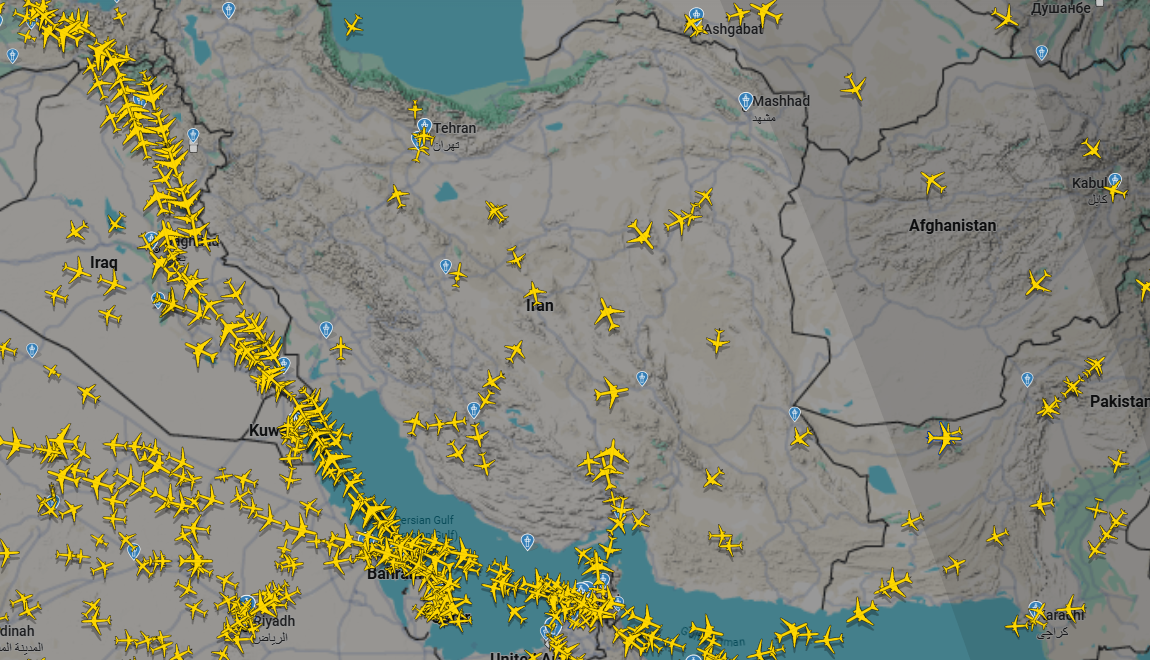
Regional Gulf operators' air traffic has largely shifted to the Iraq route, with a significant drop in overflights over Iran at UTC13:00 on January 31. A southern route through Saudi Arabia has also seen increased air traffic.
On 14–15 January, Germany’s air traffic control authority (DFS), on instruction from the Transport Ministry, advised German airlines to avoid Iranian airspace (Tehran FIR OIIX) until 10 February because of heightened regional tensions and risk from air‑defence systems.
That recommendation is embodied in NOTAM EDWW B0036/26, effective 14 January 17:05 UTC to 10 February 23:59 UTC, describing a “hazardous situation in Iran” and recommending German civil operators not enter the Tehran airspace.
Several major airlines suspended or rerouted flights across the Middle East from January 23 onwards as the prospect of a US military strike on Iran raised serious safety concerns over regional airspace, The National reported on January 25.
KLM cancelled all flights to Dubai, Tel Aviv, Riyadh and Dammam on January 23 and began avoiding the airspace of Iran, Iraq, Israel and several Gulf countries. The Dutch carrier resumed services to Riyadh and Dammam on January 27, and planned to restart Dubai flights on January 30, but Tel Aviv remained suspended until further notice, the airline said on January 28.
Lufthansa suspended flights to Tehran until at least March 29 and has been avoiding Iranian and Iraqi airspace. Its subsidiary, Austrian Airlines, extended cancellations to February 16. Night-stop flights to Tel Aviv and Amman were curtailed or shifted to daytime only.
Air France briefly suspended flights to Dubai on January 24 before resuming them the same day, stating it was continuously monitoring the geopolitical situation and adjusting schedules as needed.
British Airways temporarily suspended services to Bahrain and some overnight Dubai flights, restoring them around January 26 while keeping the situation under close review.
United and Air Canada suspended flights to Tel Aviv until further notice due to security concerns. Further cancellations are expected to be announced in the coming hours as a potential US strike on Iran is expected, according to several sources.
Unlock premium news, Start your free trial today.


