
COMMENT: Why Trump's Iran negotiations are destined to fail


When Washington agreed to Tehran's demand to relocate bilateral talks from Turkey to Oman, it signified yet another curious chapter in the Trump administration's erratic approach to Middle Eastern diplomacy. The concession, which some might interpret as flexibility, likely signals something far more ominous: the United States has already decided that diplomacy will fail, and is merely humouring the Iranians.
The fundamental problem with these upcoming negotiations is brutally simple for those who have been following. The gap between American demands and Iranian red lines is unbridgeable. Tehran has repeatedly said it isn't going to cave in and the Persian ego will likely not cave in or "drink the poison" that will make Trump and Co. happy.
The Trump administration has presented Tehran with four core requirements that collectively amount to a demand for Iran's complete strategic capitulation; these are impossible to meet.
First, Washington insists on the dismantling of Iran's nuclear programme and the transfer of all enriched uranium. Second, it demands the complete abandonment of Tehran's ballistic missile capabilities. Third, it requires Iran to sever support for regional proxy forces, including Hezbollah and Hamas. Most recently, Trump has added a fourth demand: fundamental changes to Iran's domestic policies, including amnesty for protesters and the cancellation of any planned death sentences. To be fair, there have been some signs from inside Iran that this has happened to some degree despite the thousands already dead from weeks of protests in January.
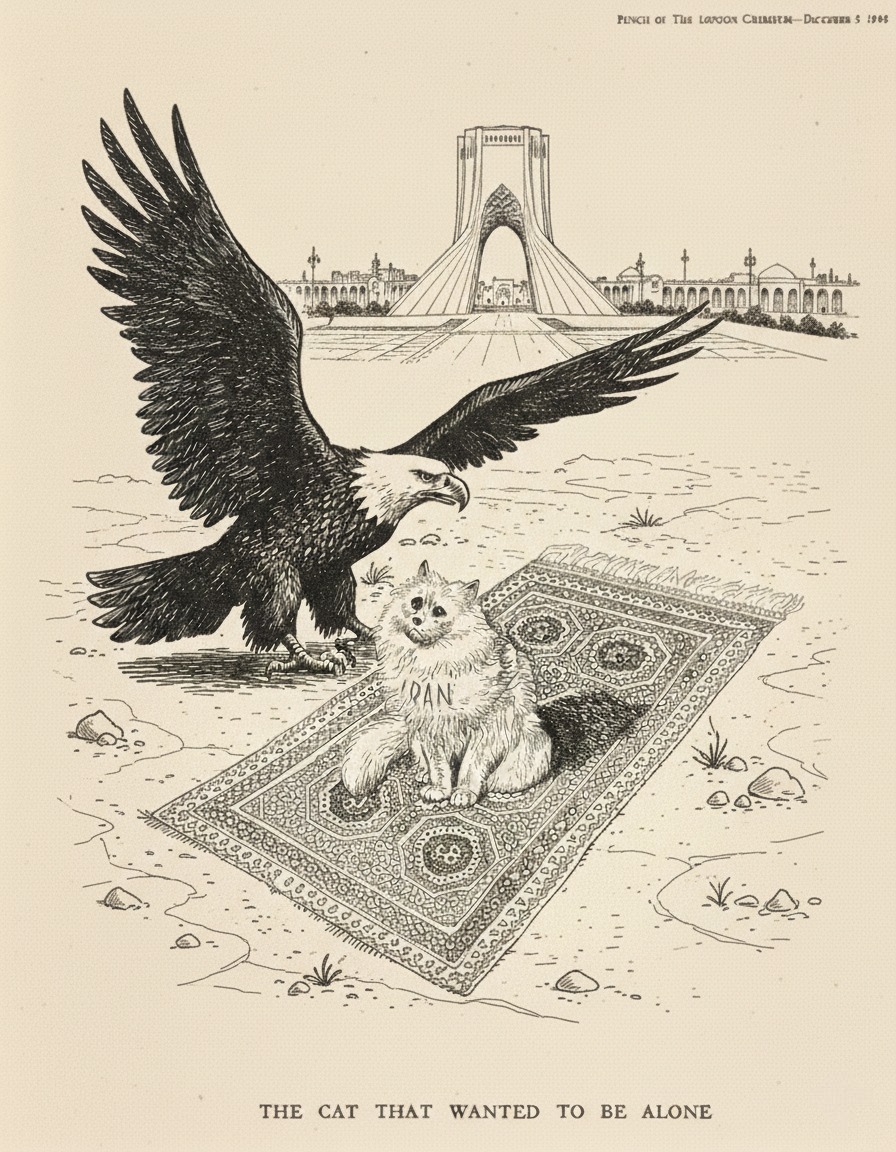
The image above is a play on a Victorian-era cartoon depicting Iran's view of the world. Despite changes in government, Iranians still seek to distance themselves from their surroundings.
Tehran, predictably, has indicated willingness to discuss only the first point: the nuclear programme. This limited engagement should surprise no one. Iran's ballistic missile programme represents the country's primary military deterrent, a non-negotiable pillar of national defence. After decades of isolation and sanctions, these weapons systems are Iran's insurance policy against American or Israeli attack. But on a more fundamental level, these are a matter of national pride for the security services and a good proportion of the national mindset.
Similarly, Tehran's network of regional allies (what Iran terms the "Axis of Resistance") forms the very foundation of Iranian foreign policy. The Shia crescent stretching from Tehran through Baghdad and Damascus to Beirut isn't just a strategic asset. It represents Iran's core geopolitical identity in a hostile regional environment. It has enabled a filter of sorts between Israel and the US and the Iranian world to the east. However, despite Tehran's best efforts, those layers (see Assad's downfall) between the Israelis and the Iranians have now all but collapsed, enabling the West and Israel to get to this stage.
Asking Iran to abandon Hezbollah and Hamas is rather like asking Britain to withdraw from the Commonwealth. Technically possible, but politically unthinkable, and it would lead to all sorts of consequences that have not been played out in the minds of Iranian planners.
The demand for internal political reforms reveals perhaps the most profound misunderstanding of Iranian politics. For the Islamic Republic to grant amnesty to protesters and fundamentally alter its domestic governance would require the regime to repudiate itself. Authoritarian governments rarely reform themselves out of existence, and the clerical establishment in Tehran has shown no inclination to pioneer such an experiment.
Trump's political calculations make these maximal demands inevitable. Having campaigned on getting tough with Iran, the president cannot afford to be seen as achieving nothing. He has repeatedly emphasised the importance of preventing Iranian missiles from threatening Israeli or American military installations. He previously pledged support to Iranian protesters, but none arrived yet. To walk away from Oman empty-handed would undermine his carefully cultivated image as a dealmaker who extracts concessions through pressure. For Trump, we have yet another ego problem, and nobody wants to be seen to get the better of, especially not the American leader.
Yet Trump's chequered negotiating history suggests something more troubling than diplomatic failure. Time and again, this administration has launched military operations precisely when diplomatic engagement appeared imminent. Before the Iranian-Israeli conflict erupted in June 2025, talks between the parties had just been announced. The pattern is unmistakable. Negotiations serve as cover for military preparations, not genuine attempts at compromise. Iran also knows this and has been rushing to fill its boots with tech from Russia and China. What exactly they have imported in recent weeks is anyone's guess.
Washington's ready acceptance of Iran's demand to relocate talks to Oman reinforces this interpretation. If the Americans genuinely believed these negotiations were critical, the venue would matter. That they conceded the point so readily suggests the talks themselves are secondary to other objectives. Oman provides an excellent backdrop for diplomatic theatre whilst military planners finalise their targeting packages.
The Israeli dimension cannot be ignored. Tel Aviv has consistently opposed any agreement that leaves Iran's nuclear infrastructure intact or its regional influence unchallenged. With tensions already elevated following last year's direct confrontation, Israeli pressure on Washington to resolve the Iranian question militarily has intensified. Trump's close relationship with the Israeli government makes him particularly receptive to such arguments. The strategic logic pointing towards military action is compelling from Washington's perspective. Diplomatic engagement provides legal and political cover, demonstrating that America "tried" peaceful resolution before resorting to force. Allied governments, particularly in Europe, can be assured that all alternatives were exhausted. Domestic opposition can be painted as naive or unpatriotic.
Moreover, military strikes against Iranian nuclear facilities or missile sites could be framed as limited, defensive actions, not the opening of a broader war. Whether such strikes would remain limited is another question entirely. Iran's likely retaliation could quickly escalate into a regional conflagration drawing in multiple actors. And Tehran have repeatedly said that cities like Dubai, which are full of Western "expats", would be front and centre of its targeting. In recent hours, the drone launches from Chabahar would also indicate Iran is ready and willing to kick things off.
The great tragedy is that this escalatory spiral appears intentional. Rather than seriously pursuing the difficult compromises necessary for a sustainable agreement (perhaps accepting Iranian nuclear capabilities below weapons-grade in exchange for rigorous inspection and limited sanctions relief), Washington has opted for maximum pressure, leading predictably towards maximum confrontation. The Omani talks, when they occur, will feature earnest diplomats presenting incompatible positions across highly polished conference tables. Communiqués will speak of "frank exchanges" and "exploring common ground". Behind this civilised façade, however, lies a grimmer reality. These negotiations are not designed to succeed. They are designed to fail.
Unlock premium news, Start your free trial today.


