
COMMENT: Kazakhstan’s multi-vector AI diplomacy faces a test of technological dependence


Kazakhstan may soon get its five minutes of fame within the context of the US-China AI race. Washington and Beijing are increasingly building separate frameworks for the technologies and supply chains that will support the global artificial intelligence industry.
The Trump administration launched Pax Silica in December 2025, billing it as a non-binding initiative coordinated by the US State Department, with the stated aim of reducing reliance on China for AI essentials, including semiconductors, rare earth elements and data centres. China in July established its own platform, the World Artificial Intelligence Cooperation Organisation, or WAICO. Notably, Kazakhstan is so far the only country in the world to have joined both frameworks.
Astana’s decision to engage with both sides, however, looks set to come under pressure. In August, Reuters reported on a draft letter prepared by the US State Department warning participants in Pax Silica against simultaneously taking part in rival initiatives. Its proposed position would make participation in the US-led framework contingent on an exclusive commitment, potentially limiting the ability of member countries to engage with the competing Chinese structure WAICO.
The language of the draft made that distinction explicit: “To be part of everything is to be part of nothing.”
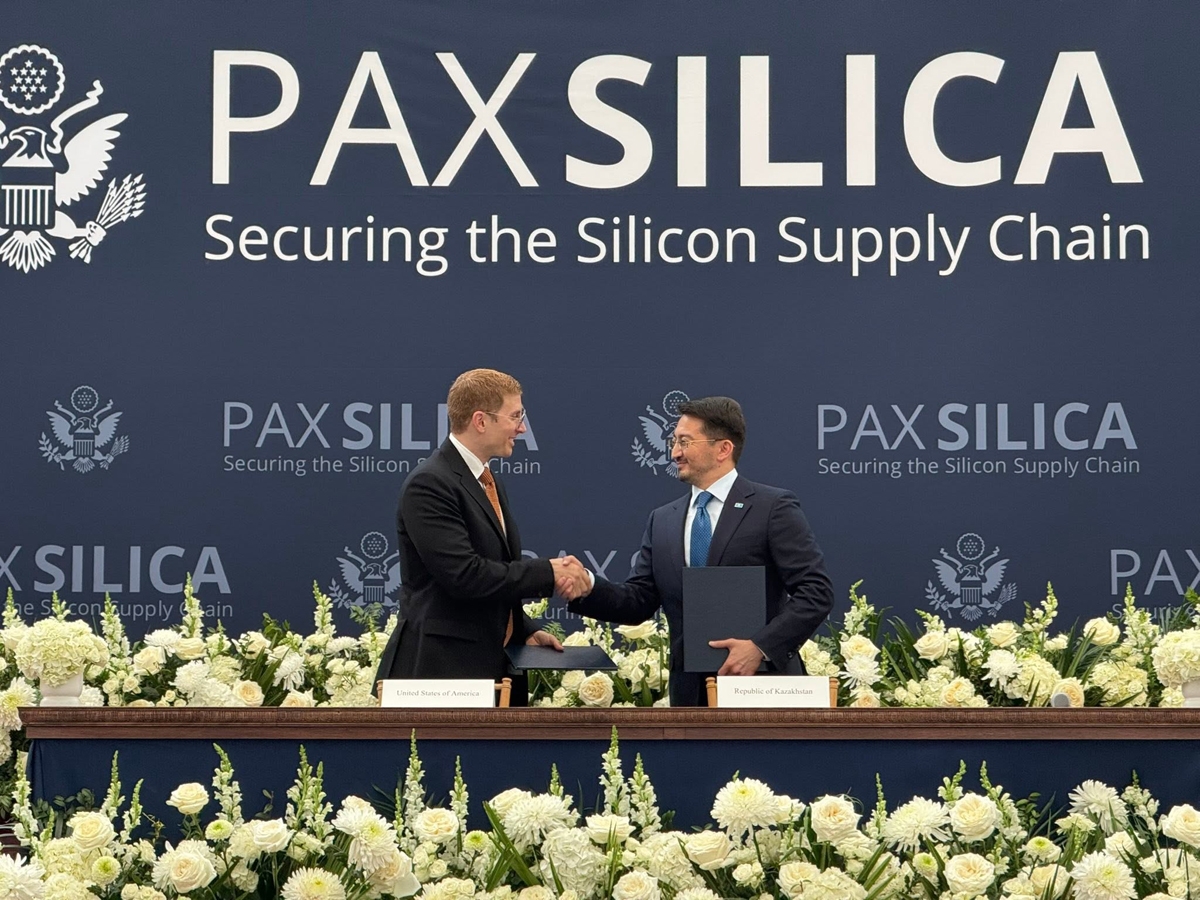
Jacob Helberg (left), US Under Secretary of State for Economic Growth, Energy and the Environment, shakes hands with Zhaslan Madiyev, Deputy PM and Minister of Artificial Intelligence and Digital Development of Kazakhstan, at the signing ceremony for Kazakhstan’s accession to the US-led Pax Silica initiative in Washington in late June (Credit: Kazakh Embassy DC, X).
Rather than treating Pax Silica as simply another international forum, the letter characterised participation in it as a commitment carrying obligations beyond the formal membership.
The letter had not been sent at the time of the Reuters report, and there was no indication that Washington had formally instructed Kazakhstan to withdraw from either Pax Silica or WAICO. But given that Kazakhstan is the only known member of both organisations, one might as well assume that the letter is intended for Astana.
If the US moves forward with the letter, Kazakhstan may find itself in a very difficult position.
Choosing to comply with the US demands would run contrary to the multi-vector approach that shapes Kazakhstan's foreign policy. Refusing could strain ties with Washington and potentially carry consequences for the country’s access to Western technology and investment.
No room for multi-vector AI policy?
Wilder Alejandro Sanchez, president of Washington-based Second Floor Strategies, told RFE/RL that Kazakhstan may not have anticipated such a US standpoint.
“I don't think Astana made a mistake by joining both blocs. But Astana seems to have miscalculated one thing: It apparently did not expect Washington to draw a red line and tell Kazakhstan that it had to choose between the two blocs,” Sanchez was reported as saying.
He suggested that Astana could seek talks with Washington while making clear that it does not want to have to choose between the US and China.
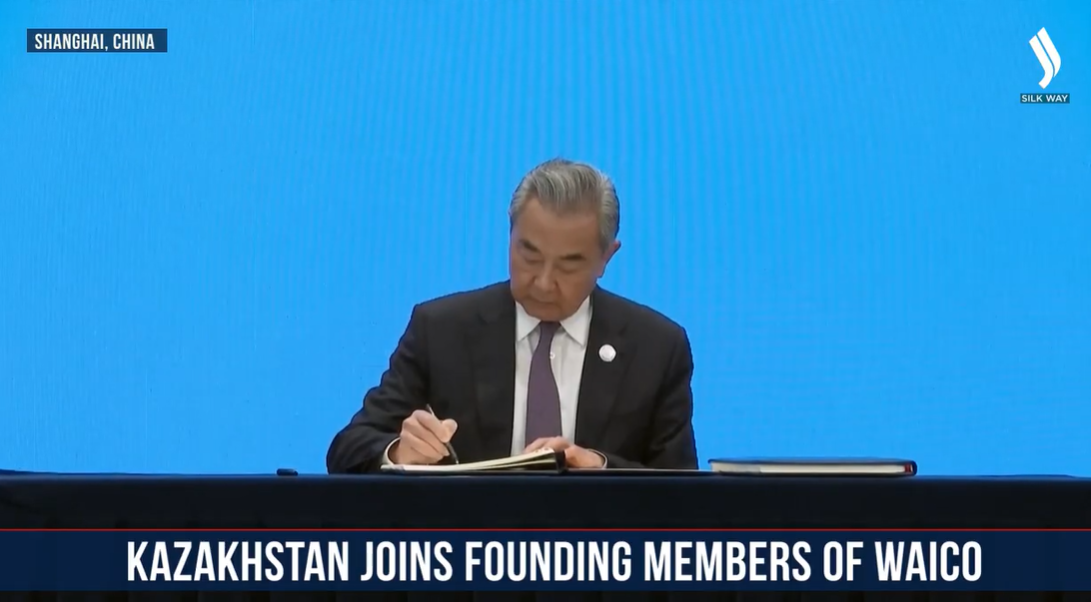
In July, Silk Road TV reported on Kazakhstan joining China's WAICO initiative at a ceremony in Shanghai attended by Chinese leader Xi Jinping (Credit: Screenshot, Silk Road TV YouTube channel).
For now, Kazakhstan has not been forced to make such a choice. But the emerging contest suggests that its traditional multi-vector policy – roughly amounting to get on with everyone, upset no-one – may face a stiffer test in technology than it has in other areas.
Can Kazakhstan even choose?
On June 15, the government announced a $10bn package of agreements involving US-based Firebird and NVIDIA for AI infrastructure, advanced computing and data centres in Kazakhstan. The centrepiece is the Data Center Valley project in Ekibastuz in the northeast of the country that will run on copious volumes of local coal-fired power provision.
The project clearly amounts to more than mere diplomatic participation in Pax Silica. It is physical infrastructure.
Kazakhstan's National AI Platform states that its sovereign computing infrastructure uses NVIDIA H200 accelerators, with two supercomputers listed in the TOP500.
That raises a more difficult question for Kazakhstan’s multi-vector strategy: if its most important AI computing infrastructure is built around American chip technology, how much freedom would Astana actually have if Washington imposed technology restrictions?
The Brookings Institution raised a such questions in a report published on September 8, imagining a scenario in which middle powers attempted to remain semi-independent from Pax Silica.
“Even a carefully framed middle-power effort would likely invite a US reaction,” the report said, pointing to possible measures including licensing conditions for advanced GPUs, tighter end-use requirements in cloud contracts, security relationships used to discourage participation or the use of the Section 232 framework covering semiconductors and semiconductor manufacturing equipment.
That creates further uncertainty over Kazakhstan’s manoeuvrability.
Conversely, some observers believe that forcing an ultimatum on Kazakhstan would backfire against US interests.
Break with China impossible
Temur Umarov, a fellow at the Carnegie Russia Eurasia Center who focuses on Central Asian countries’ domestic and foreign policies and China’s relations with Russia and Central Asia, says Kazakhstan is unlikely to make a clean choice even if Washington puts pressure on Astana.
“If the US puts Astana in front of an ultimatum in the spirit of the Cold War, it will be a step backwards for American foreign policy in Central Asia,” Umarov wrote on his Telegram channel.
For Umarov, such an approach would run against the region’s established logic, in which successful external partners have had to coexist with Russia and China rather than attempt to displace them.
He further argues that breaking away from China would neither be easy nor necessary.
“Rather than issuing direct ultimatums or prohibiting cooperation with the United States or anyone else, Beijing typically relies on the tools it already has at its disposal — and there are many of them,” he said. “Given that Chinese corporations and brands have spent years capturing market share, exporting affordable technologies and offering attractive investment projects in digital infrastructure, gradually but firmly tying countries to their ecosystem, it would not be easy to abandon large-scale technological cooperation with China – nor would there necessarily be a reason to do so.”
“Astana and its neighbours in the region will simply do what they are good at – quietly feeding each of the great powers the illusion of their exclusive loyalty while cooperating with everyone,” Umarov added.
Indeed, Kazakhstan’s diplomacy in the region has long relied on “feeding the illusion” of exclusive loyalty to both Russia and China. Some would say this policy is a geographic inevitability that pre-dates modern Kazakh statehood, reaching back to the days of the Kazakh Khanate, which had to play this game with the Russian Empire and China at the time. Adding the US to this equation would not be out of the question.
Can the US actually force a choice?
An analysis published by the Ankara Centre for Crisis and Policy Studies on September 8 similarly argues that Kazakhstan is unlikely to respond to pressure by explicitly choosing one side.
Instead, the analysis suggests Astana could continue providing enough cooperation to maintain relations with both major powers while avoiding commitments that would irreversibly limit its options.
One possible approach is “strategic ambiguity”: reassuring Washington of Kazakhstan’s interest in technological cooperation while avoiding commitments that explicitly exclude China, and presenting participation in Chinese-led initiatives as instruments of international cooperation, technological development or AI governance rather than geopolitical alignment.
Such an approach would allow Kazakhstan to postpone an irreversible decision and retain the ability to adjust its position as technological competition develops.
Kazakh political analyst Rustem Kurmanguzhin similarly suggested that a way could still be found for Kazakhstan to participate in initiatives associated with both Donald Trump and Xi Jinping.
“It is possible that both the United States and China will find a way to ensure our country’s participation in initiatives led by both Donald Trump and Xi Jinping,” he wrote for Cronos Central Asia.
He pointed to discussions between the US and China over the “rules of the game” in high technology as a possible indication that the two sides could eventually find a way to accommodate overlapping participation.
That said, some analysts argue that there is no need to force a choice on Kazakhstan as the country’s multi-vector approach could be a boon for the US rather than an inconvenience.
Ken Moriyasu, a senior fellow at the Hudson Institute, describes Kazakhstan as one of the most important “swing states” in the US-China competition and argues that its flexibility is itself strategically valuable to the US.
“This very flexible stance of Kazakhstan is very beneficial for the US strategy,” Moriyasu told The Astana Times.
“Keeping Kazakhstan a trusted ally and partner in this endeavour is more important than forcing it to choose sides in Pax Silica,” he added.
It is also worth noting that Kazakhstan’s significant critical-mineral reserves add to its importance in the emerging AI supply chain.
Just perhaps the aforementioned draft letter is highly unlikely to ever leave the drafting room.
Unlock premium news, Start your free trial today.


