
China largely insulated from global energy price shocks


Events linked to the conflict in the Middle East are expected to increase China’s overall energy import bill, but the economy is less dependent on oil and natural gas than many of its peers, while large domestic reserves built up in recent years can be deployed to limit pass-through to consumers, a note from Capital Economics says. In addition, higher global energy prices may even benefit Chinese exporters, allowing them to capture greater market share.
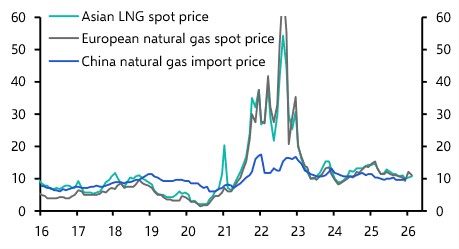
Image - Capital Economics
Although China is the world’s largest net oil importer and a major purchaser of Iranian crude, several factors mitigate the impact on its economy, CAPECON adds. The global nature of the oil market means all importers face similar price increases, and sanctions on Iranian oil have had little effect on the average cost of China’s crude overall, which continues to track the Brent benchmark closely.
Furthermore, natural gas import costs are also relatively insulated from spot price fluctuations. Nearly half of China’s imported gas is delivered via long-term pipeline contracts overland from Turkmenistan and Russia, while the remainder, sourced as LNG, is mostly covered by long-term agreements that reduce exposure to volatility on the markets.
As such, China’s energy intensity is lower than many major economies, partly due to the rapid adoption of electric vehicles and renewable power, but primarily because coal remains the dominant fuel across the country. Yet while global coal prices have risen following Middle East events, the increases are much less than those seen in the oil and gas sectors. Also, with 90% of China’s coal consumption sourced domestically, policymakers retain scope to manage prices.
The country also maintains substantial crude reserves, estimated at 1.3bn barrels across strategic and commercial stockpiles, which is equivalent to around 120 days of imports. Authorities in China and state-owned refineries have previously deployed these reserves during price surges, and regulators adjust retail fuel prices every ten days to limit volatility and dampen pass-through to consumers.
Added to this is the fact that around 20% of China’s oil consumption goes to supporting the production of goods for export, which in turn allows some of the energy cost increases to be passed to foreign buyers. While higher energy prices will weigh on global growth, they may also make Chinese exports more competitive, particularly in green technology sectors.
Because of this, and according to CAPECON, the overall impact on China’s economy is expected to be modest. Inflation will be higher than otherwise, reducing real incomes but only slightly. However, the pressure is unlikely to require policy tightening, meaning that compared with many other countries, China is therefore well positioned to absorb the current energy price shock.
Unlock premium news, Start your free trial today.


