
Brazilian beef drives a quarter of global commodity-linked deforestation


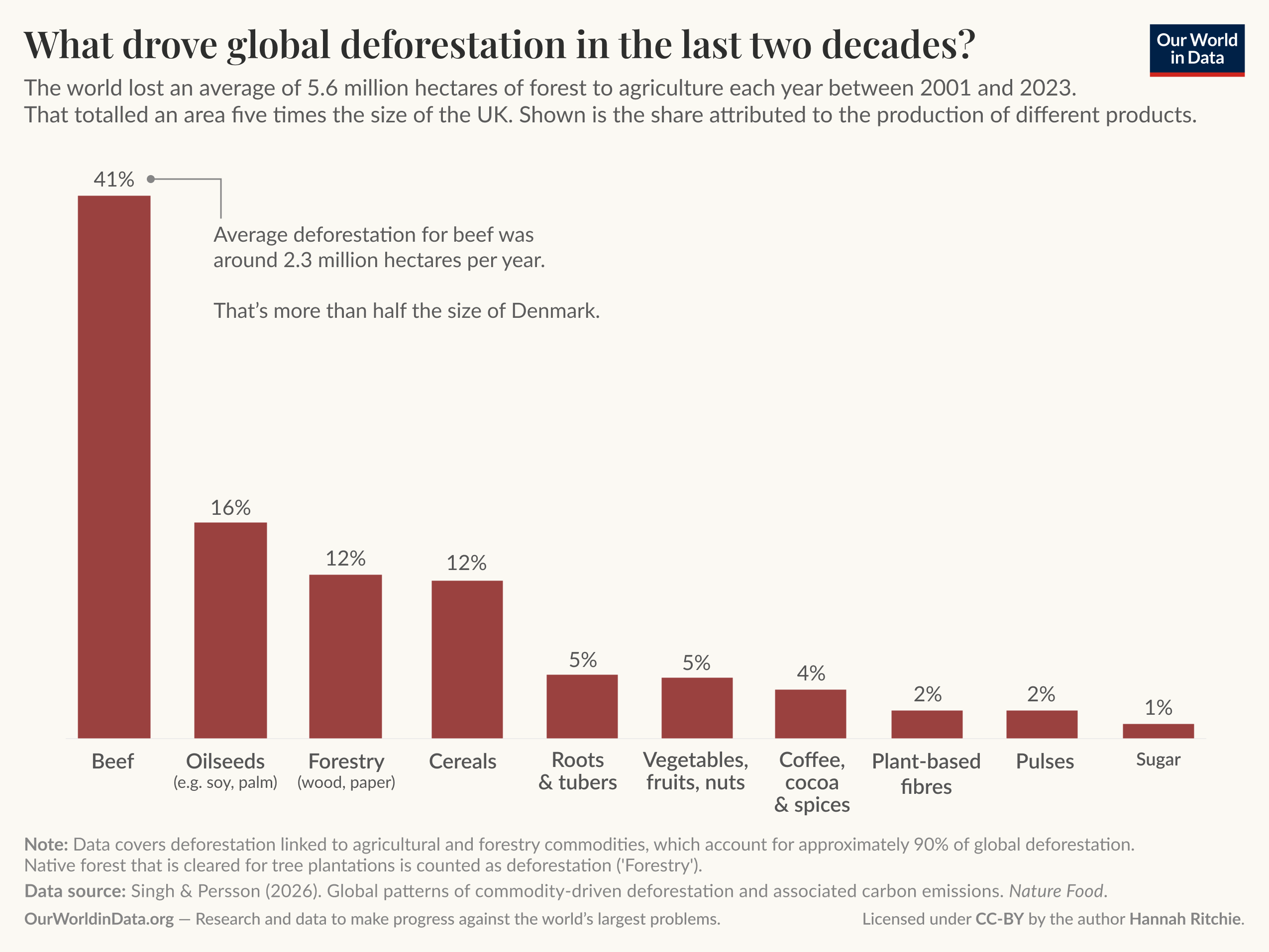
Beef production drove 41% of global forest clearance for farming and plantations in 2001-2023, Our World in Data reported on August 3.
Total clearance across all commodities reached 128mn hectares, about five times the UK’s land area, or 5.6mn hectares a year. Brazilian beef accounted for roughly a quarter of that total. A separate trade-adjusted estimate puts Brazilian beef-related clearance at about 27mn hectares in 2005-2023. The figures use an updated version of the DeDuCE dataset developed for Global patterns of commodity-driven deforestation and associated carbon emissions, a study of 184 commodities across 179 countries published in Nature Food in February.
About 85% of Brazil's commodity-linked deforestation was associated with domestic demand in 2005-2023, according to the trade-adjusted estimates. The remaining 15% was linked to exports across many markets. These are shares of the deforestation footprint, not beef export volumes. The EU deforestation regulation covers relevant goods placed on or exported from the EU market; it does not directly regulate Brazilian domestic consumption.
Application has been postponed twice. The main obligations now apply from December 30, 2026, with most micro and small operators given until June 30, 2027. Micro and small operators already covered by the EU Timber Regulation also face the December deadline. Member states approved the second delay and filing simplifications in December 2025.
Mercosur's own members have yet to agree how to divide the tariff-preference quotas they won under the bloc's trade agreement with the EU, with foreign ministers leaving a Montevideo meeting on September 2 without a formula, while Switzerland's lower house approved its own Mercosur deal on September 16.
Washington has allowed a temporary waiver of out-of-quota tariffs on up to 300,000 tonnes of beef for ground-beef production over 90 days, aimed at lowering US retail prices. IntelliNews reported that the US became Brazil’s largest beef buyer in August.
Oilseeds were the second-largest driver at 16%, split between soy in South America and palm oil in Indonesia and Malaysia, which between them grow almost all of the world's supply. Palm oil clearance has fallen sharply since the early 2010s under Indonesia's 2018 moratorium, Malaysian limits on plantation area and buyer certification schemes, although Indonesia still accounts for 6% of global commodity-linked deforestation through that crop alone.
Argentina has been lobbying Brussels to drop a proposal that would strip soybean biodiesel out of the EU's renewable energy rules, and Indonesia has negotiated a trade pact removing tariffs on 90% of its EU export lines from 2027.
Cereals accounted for 12% of the total and roots and tubers a further 5%, both concentrated in Africa, where yields have not risen fast enough to meet demand and extra output has come from clearing ground rather than from raising production per hectare. Chandrakant Singh and Martin Persson make a related point about what gets watched: staple crops such as maize, rice and cassava together drive around 11% of agriculture-linked deforestation, more than cocoa, coffee and rubber combined, yet attract almost none of the scrutiny.
“Deforestation's links to food production have long been studied, but have often focused on some products, such as beef, soybeans and palm oil,” said Persson, a researcher at Chalmers University of Technology, in the announcement of the findings.
The estimates suggest that measures targeting domestic demand in Brazil would need to accompany action by importing markets to address the largest share of its deforestation footprint.
Unlock premium news, Start your free trial today.


