
BEYOND THE BOSPORUS: How the Turkish opposition helps sustain the myth of real elections


All the world’s a stage and nothing more so than the platform on which Turkey’s so-called democracy plays out. Right now, those who tread the boards are acting out yet another exasperating script, with the latest farce following in the wake of June 7 by-elections held in six “beldeler”, large villages with muncipalities.
As usual, the poll outcomes have been decried by officials of the main opposition Republican People’s Party (CHP) officials as an instance of the government “stealing” mandates. The real significance in scenes such as this, however, lies not in the ballot irregularities, but in the role the CHP plays in legitimising the entire spectacle.
Based on legislation passed in 2012, the six locations were stripped of their municipality status and downgraded to mere villages because their populations had fallen below the 2,000-threshold. Subsequent to court proceedings, the villages were restored as beldeler, meaning by-elections were required.
Posing as competitive authoritarianism
For decades, the CHP has stuck to a well-documented approach of institutional passivity when it comes to systemic electoral schemes. That is the case even though its structural compliance plays into the hands of the ruling apparatus.
In fact, the CHP participates vigorously in what are compromised races, acting as if fair ballots are possible and circulating the narrative that Turkey still holds meaningful, authentic elections.
It is thanks to the docile, obedient CHP’s exits and entrances on the stage that the mainstream (media, academics and so forth) can go on describing the country’s political regime as an instance of competitive authoritarianism.
“Transported” voters
These recent micro-elections provide a clear look at this dynamic. According to data provided by Gokhan Zeybek (@gokanzeybekCHP), an MP and senior party executive who serves as the CHP deputy chair “in charge of local governments and resilient cities”, voter registrations in the six small localities spiked from 4,275 in the 2024 elections to 10,791 by May 2026.
The mechanism that achieved this is clear. There was systemic “transporting” of outside voters executed by local civil registries and state district governors (kaymakam) that effectively diluted the native electorates to guarantee government-preferred outcomes.
Invitation to “perform”
To the outside observer, glaring statistical anomalies such as those described would render an election functionally “faked”. To the CHP, however, the poll results amounted to an invitation to “perform”.
Instead of withdrawing from clearly rigged contests or mounting a coherent systemic challenge, the party's leadership treated the polls with the gravitas worthy of real democratic battles.
Ozgur Ozel – who in May was ousted from his chairmanship of the CHP by a court order that reinstated his predecessor – held high-profile rallies in the beldeler. Sycophants and loyalists lined up to praise his leadership.
Nobody at the election regulator
Observers were treated to another energetic campaign performance that effectively masked the complete lack of institutional pushback from the CHP. The party in fact plugged into the elections without even a single official representative present at the Supreme Election Council, or YSK.
The party’s representative Hadimi Yakupoglu had been dismissed on May 22 by Kemal Kilicdaroglu, the former CHP leader who the day before replaced Ozel by court order.
No more than a safety valve
The CHP’s response to the predictable ballot box defeat highlighted how it plays the sustained role of safety valve for public frustration. With the elections lost, Zeybek and other party officials publicly stated that the elections were stolen.
Yet, rather than demanding systemic reform or legal accountability, they starkly and explicitly left further responsibility to the “conscience of society”.
“The election boards have not taken into account the objections raised. Under these conditions, if the outcome is the ‘national will,’ then we call it the national will. We are recording what happened and leaving it to the discretion of the public conscience,” Zeybek wrote in a tweet.
Manufacture hope. Lose. Repeat
The cycle of manufacturing hope among the electorate in an engineered system is central to the CHP’s actual role in Turkey’s political system. Even as the party validates orchestrated losses in local elections, Ozel maintains his regular refrain that the CHP candidate will comfortably win the next presidential election.
By constantly pointing to a future democratic victory that is coming within grasp, the CHP keeps voters engaged in the voting process. To a regime reliant on maintaining the appearance of a pluralistic democracy for onlooking international markets and domestic audiences, the CHP’s willingness to play its part remains its greatest asset.
Friends in high places
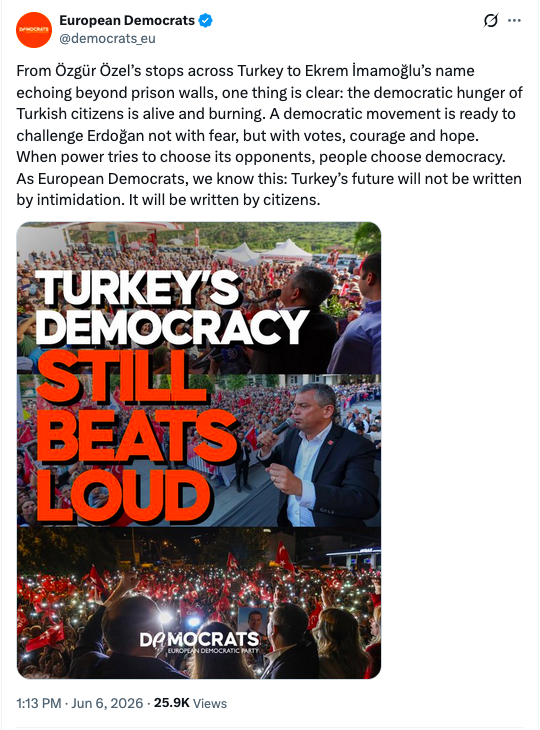
Tweet: This European democratic party is a serious force that will stop the renaissance of fascism on the continent.
The role that CHP plays in Turkey’s political system is on reflection a global phenomenon. Wherever a Nazi Party rises in the world, there is a Social Democratic Party of Germany (SDP) on hand to provide assistance while playing the opposition.
Was it not the high and mighty Democratic Party of the US that nominated a man who was not able to talk or walk against Donald Trump, in whose name an angry mob of supporters took part in an organised assault against Congress that cost five lives?
Unlock premium news, Start your free trial today.


