
Battle of the Berdimuhamedovs. Is Turkmenistan’s ruling regime at risk from a father and son feud?


A simmering family feud between Turkmenistan’s President Serdar Berdimuhamedov and his predecessor father Gurbanguly Berdimuhamedov threatens to topple both of the ruling duo from power, according to Central Asia expert Galiya Ibragimova.
While in public, Serdar, 45, continues to play the “obedient son”, he is in fact becoming increasingly independent, is willing to break with his 69-year-old father’s legacy and has stepped up a purge of regime figures, removing allies and relatives of Gurbanguly from their posts, Ibragimova writes in a commentary published by Carnegie Politika on October 7.
‘Twin helmsmen’
Describing the father, who takes the title “National Leader of the Turkmen People”, and son as the “twin helmsmen”, she assesses: “Both project a united front in public, but it is abundantly clear that Gurbanguly Berdimuhamedov—who never intended to hand over full power to Serdar—is unwilling to accept his son’s growing independence. Their intensifying rivalry could undermine both the regime’s stability and their ability to hold on to power—especially considering they acquired it largely by chance.
“Serdar inherited the presidency back in 2022 but has only now begun the largest-ever purge of officials during his tenure. Dividing high-ranking Turkmen officials into ‘father’ and ‘son’ factions is rather difficult—many of them began their careers under Gurbanguly and continued under Serdar. However, enough evidence has accumulated over the past few months to suggest that the recent shake-ups are meant to eject the team Gurbanguly left behind to help his son get comfortable.”
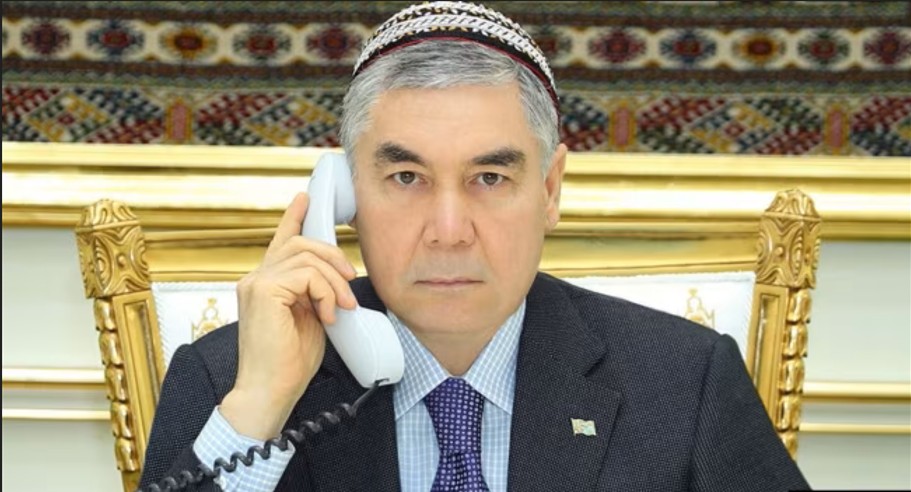
Ex-president Gurbanguly Berdimuhamedov may be having a hard time keeping up with the scheming of his successor son Serdar (Credit: www.tdh.gov.tm).
Ibragimova points out that many of Serdar’s new appointees in his efforts at sidelining his father are his age or slightly older. “It seems,” says Ibragimova, a researcher and freelance journalist, “that the president wants to create a new generation of elites, indebted to him rather than to his father. Furthermore, by ridding himself of the old team, Serdar gains more freedom from Gurbanguly’s influence.”
Purging the security apparatus
Serdar’s first target in the purge appears to have been the security apparatus. Major General Nazar Atagaraev was dismissed from his post as Minister of National Security ostensibly due to corruption within his agency, says Ibragimova.
Atagaraev was succeeded by Dovletgeldy Meredov, previously chief of Serdar’s personal security detail.
Serdar has also replaced the Border Guard Service chief, veteran official Yazgeldy Nuriev, a holdover from Gurbanguly’s 15-year tenure.
Adds Ibragimova: “It is quite telling that the current purge has not affected the Interior Ministry. This is apparently because Serdar appointed his own man—Muhammet Hydyrow—as minister immediately upon taking office in 2022. Hydyrow appears to have maintained the president’s trust so far.
“Serdar also shook up the energy sector—the country’s primary source of revenue. Batyr Amanov, the long-serving deputy prime minister responsible for the development of Turkmenistan’s oil and gas sector, was dismissed. He was replaced by Guvanch Agajanov, the head of oil company Turkmenneft, a close associate of Serdar. Agajanov kept his position as head of the company.”
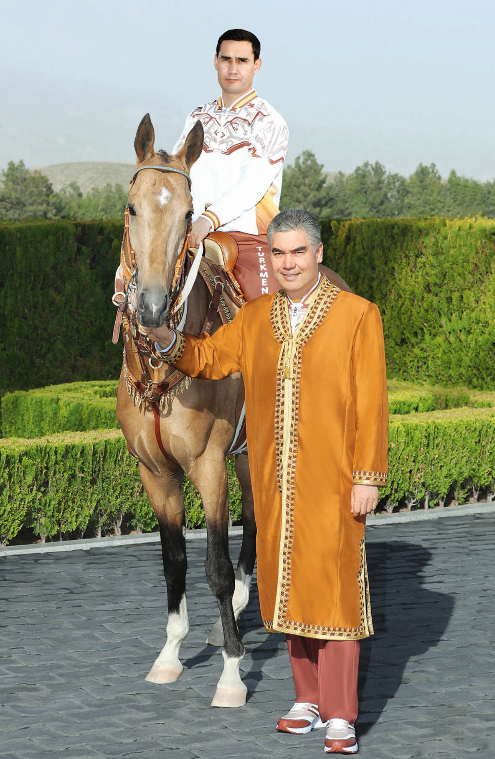
Another picture of unity from the state propaganda machine (Credit: Turkmen government media).
Tackling the regional elites, Serdar has replaced the heads of the country’s three largest regions, Mary, Balkan and Lebap and the leaders of the three key cities, Turkmenbashi, Turkmenabat and Mary.
Two deputy prime ministers, the health and culture ministers and a number of other officials were also canned.
Ibragimova details how relatives of Gurbanguly—at least those not directly connected to Serdar—have been swept up in the purge.
She says: “After dismissing his father’s sister, Gulnabat Dovletova, Serdar went after her son—his cousin Batyr Dovletov, the owner of large tracts of commercial real estate. In August, a number of buildings belonging to Dovletov were demolished in one district of Ashgabat by personal order of the president.
“Serdar is locked in a behind-the-scenes power struggle with his sister, Oguljahan Atabayeva, whom their father is promoting as a politician. Two years ago, Gurbanguly appointed her vice president of his charitable foundation. Since then, she has gradually assumed the role of first lady, meeting with foreign politicians and giving interviews to foreign media. Her visibility stands in stark contrast to Serdar’s behavior—he avoids journalists—and has sparked rumors that Gurbanguly is keeping his daughter around in case his son gets too big for his britches.”
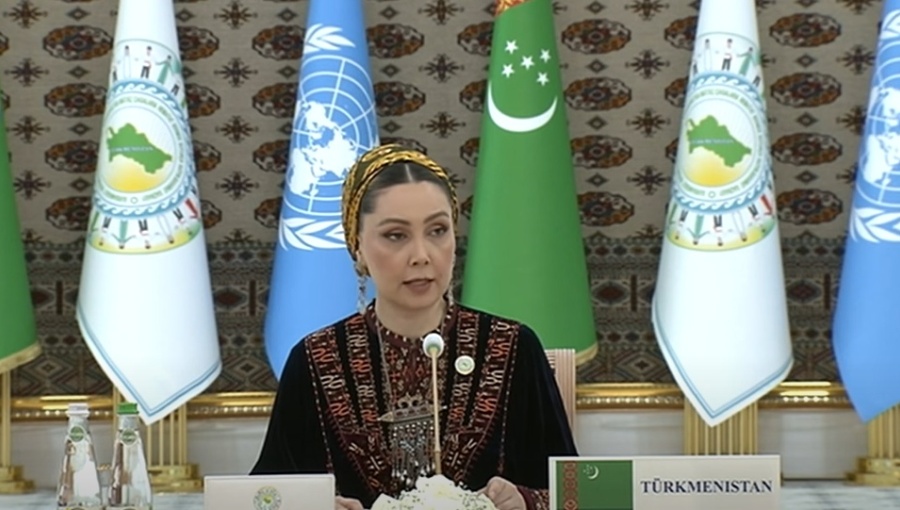
Serdar's power struggle is thought to extend to a battle to marginalise his sister, Oguljahan Atabayeva, whom their father is promoting as a politician (Credit: Homeland News, screenshot).
Ibragimova recounts how, at the start of his presidency, Serdar was “seen as a totally inexperienced politician, completely dependent on his father to make decisions. However, within the first few months of taking office as president, he cautiously began reshuffling his own team and weeding out his father’s appointees”.
Tourists banned from photographing Gurbanguly portraits
Abroad, observes Ibragimova, Serdar is already seen as a politician in his own right rather than the former president’s son and is growing increasingly confident in negotiations with foreign leaders in various settings.
“This international recognition,” she adds, “strengthens Serdar’s position domestically among both the elite and the general public. After being known as ‘Arkadagli Serdar’ (‘Serdar, supported by Arkadag’—the latter being his father’s official title) in the early years of his tenure, Serdar now wants to shed that image. Portraits of the former president in Ashgabat have been moved to the outskirts of the city, while the central districts of the capital are mainly adorned with images of Serdar. Foreign tourists are prohibited from photographing portraits of Gurbanguly; they are only allowed to take pictures of the current president.”
Finding it increasingly hard to influence Serdar’s decisions, Gurbanguly can do little as the chairman of his own political council, the Halk Maslahaty, as it has remained a largely ceremonial institution, says the analyst.
Nevertheless in his efforts to maintain some influence, Gurbanguly remains in the public eye, holding, writes Ibragimova, “instructive conversations with officials, young people, athletes, musicians, and artists—and, most importantly, with his son, the president. They, in turn, show him respect in every way.
“Foreign partners also give him attention: Whenever Gurbanguly attends an international event in his son’s place, he gets the red-carpet treatment. However, by all accounts, it still bothers him that most international attention now goes to Serdar. It may have been particularly painful to watch Serdar meet with Donald Trump as part of the ‘Central Asia + U.S.’ format—Gurbanguly himself is not personally acquainted with the American president.”
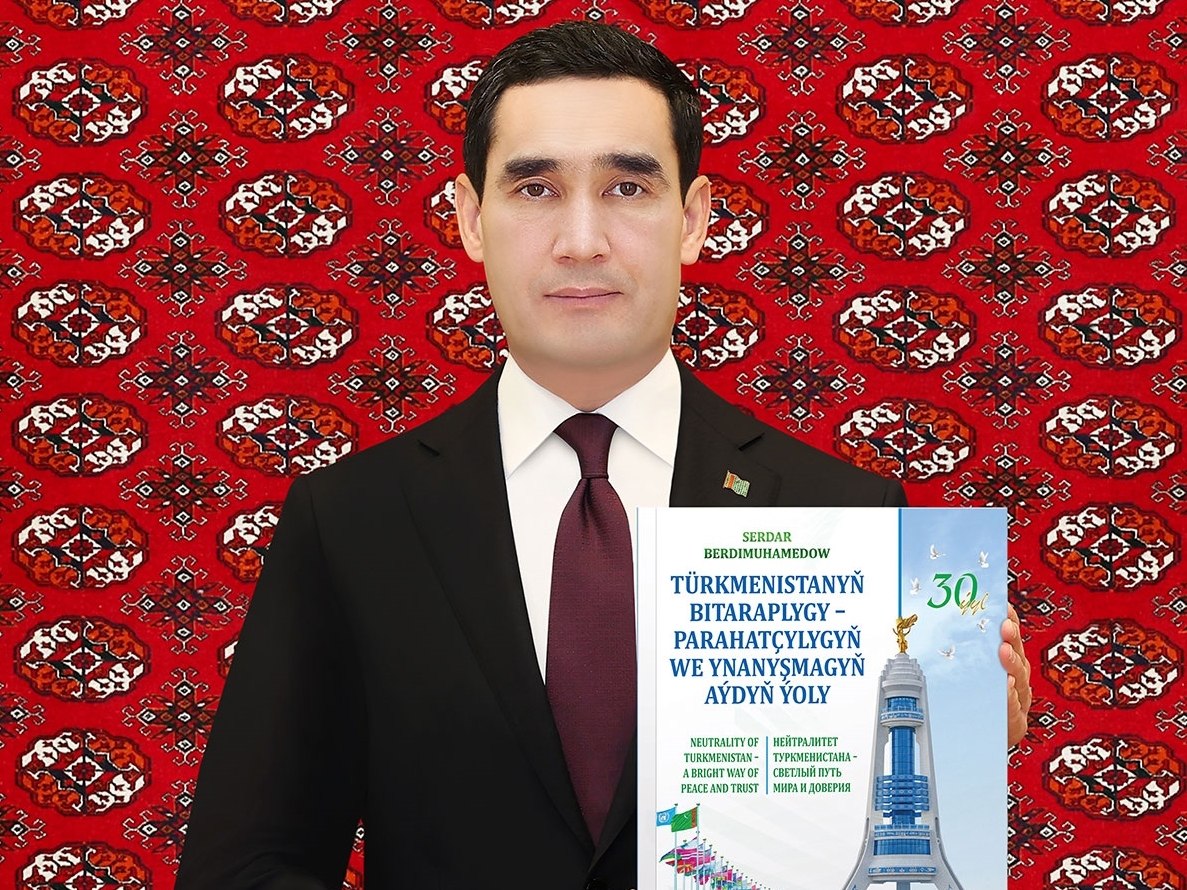
As president, Gurbanguly was known for the dedication he showed in developing his personality cult. Serdar is now building one of his own. Part of that is authoring and releasing books (Credit: Handout, gov.tm).
Interestingly, last year, Gurbanguly turned up in Florida for a working trip that coincided with Trump’s first World Summit—an initiative promoted as an alternative to the UN. “Turkmenistan was not invited to the summit,” explains Ibragimova, “but it appears that Gurbanguly had hoped to attend in person. Efforts to convince the American side of the need for Trump to meet specifically with the former president—even though the summit was attended by sitting heads of state—were unsuccessful. The status of Hulk Maslahaty Chairman apparently meant little to Trump’s inner circle and the summit organizers.”
Windsor horse show meeting with King Charles III
A trip to the United Kingdom in May this year went slightly better for Gurbanguly, says Ibragimova, writing: “In May 2026, he attended the Royal Windsor Horse Show and met with King Charles III. The British side emphasized the importance of cultural and diplomatic ties, while Gurbanguly once again appeared not merely as a former president, but as the ‘National Leader of the Turkmen People’ and chairman of the Halk Maslahaty.”
The rivalry of the two Berdimuhamedovs will most likely only intensify, adds Ibragimova, while judging that it is “unlikely to escalate into an open conflict”.
Father and son, she concludes, “do share one common interest, after all: to keep power, resources, and influence in the hands of the Berdimuhamedov family.
“If the tension simmering between father and son comes to a boil, both risk losing power. No matter how much people claim that the Turkmen regime has stamped out dissent, those eager to undermine the ruling family are waiting to come out of the woodwork at the first sign of a crack emerging in the system. So for now, Gurbanguly and Serdar Berdimuhamedov must project unity—the fate of their regime depends on it.”
Unlock premium news, Start your free trial today.


