
Arched brows as Turkey releases official inflation at 2% m/m despite war effects


Turkey’s consumer price index (CPI) inflation officially edged down to 30.87% y/y in March from 31.53% in February, the Turkish Statistical Institute (TUIK, or TurkStat) said on April 3.
“TUIK inflation” (the reader familiar with the workings of TUIK knows that that is said advisedly) stood at 44% y/y at end-2024. The indicator hovered at around 33% between July and October 2025 while it has hovered around 31% since November.
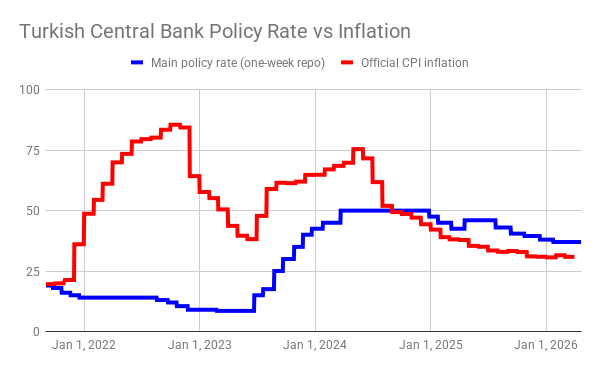
Chart: Annual inflation vs policy rate.
It is not advisable to plan, price or draw inferences based on TUIK data. There is widespread concern about the reliability of Turkey’s official data series.
At 31%, Turkey remains in fifth place in the world inflation league.
Rosy outcome despite war effects
TUIK also posted a monthly official inflation figure of 1.94% for March after releasing 2.96% for February and 4.84% for January.
TUIK, as we know, is truly professional as it goes about its business. Inflation has been the talk of the town since economic consequences of the Iran war reared their ugly head and TUIK knew that the media would expect a bone. Thus TUIK threw hacks the energy-shock bone of 4.5% m/m inflation in transportation prices.
At the same time, the celebrated official data provider managed to deliver a decline in headline inflation by cutting some points from services inflation.
End-2026 expectations moving through 30%
On February 12, the central bank raised its end-2026 official inflation “forecast” range to 15-21% in its latest quarterly inflation report. It was moved up from the previously stated range of 13-19% provided in the previous quarterly report released in November.
Even prior to the February 28 US/Israeli attack that started the latest warfare directed at Iran, the realisation was expected to come in at above the 20%-level at end-2026. Depending on the course the oil price takes from here, forecasts might be expected to break through the 30%-level.
On May 14, the central bank will release its next quarterly inflation report, the second of 2026. It will include updated forecasts and a look at the war impacts.
Simsek’s oil price forecast lifted to $85
In its latest February report, the central bank said it expected the Brent oil price to average in the $60s per barrel in 2026.
Based on the central bank’s previous estimates, the authority calculates a headline inflation increase of about 0.8pp per each 10% increase in the Brent oil price.
On April 1, Turkey’s finance minister, Mehmet Simsek, and central bank governor, Fatih Karahan, were in London to reassure the finance industry that they were still offering attractive carry trade opportunities.
The USD/TRY pair remains under control. The central bank has so far managed an adequate response to the portfolio outflows. TUIK has managed the oil price shock. There’s no need to further sell Turkey. Indeed, it’s worth buying some.
The finance ministry released the slides Simsek used in his presentation to investors entitled, “War, oil and the Turkish economy?”
The presentation showed that Turkey’s managers of the economy are currently working with an expected $85 per barrel average Brent oil price in 2026, which would add between 3.6 and 4.4 percentage points to end-2026 annual inflation.
An average of $85 is, of course, right now seen as too optimistic amid Brent prices registering above $100.
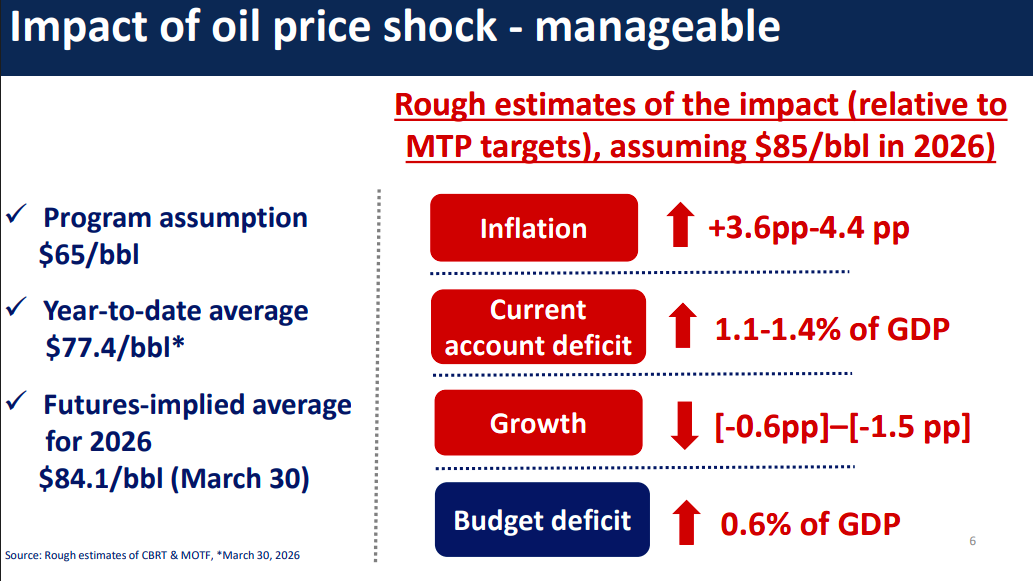
Slide: Simsek’s slide on the oil price.
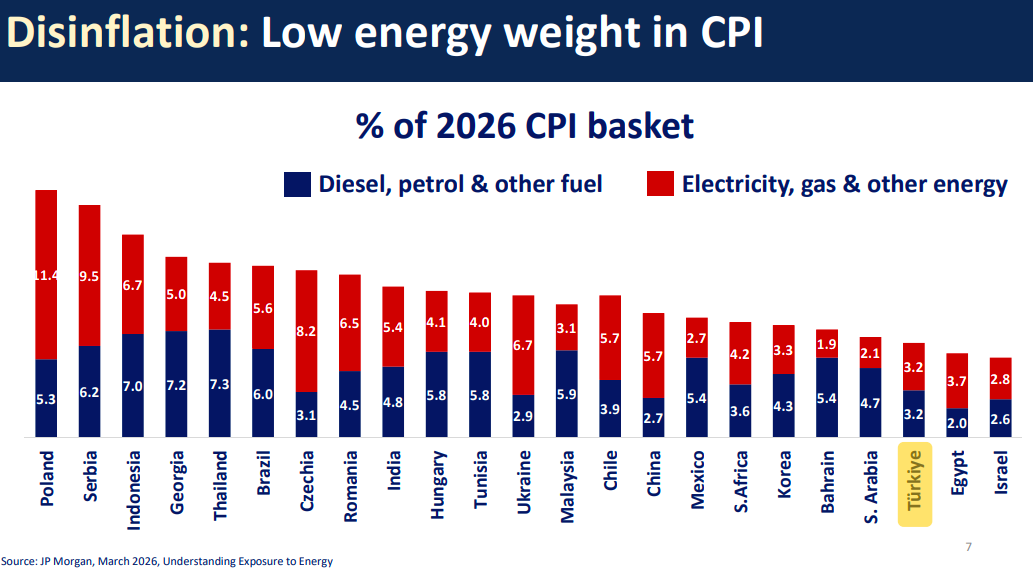
Slide: Perhaps the less said about Simsek’s use of this slide, the better. Are investors to think the official figures will evidence astonishing economic control despite anything and everything? Are economists expected to applaud nuanced methodology? Or appreciate being beaten about the head with a methodological club?
April 22, next MPC meeting
On April 22, the central bank’s monetary policy committee (MPC ) will hold its third rate-setting meeting of the year. Expectations for a hike of up to 300bp are presently growing stronger.
Prior to the February 28 onset of the conflict, the central bank was delivering a rate-cutting cycle. That brought the main policy rate (one-week repo) rate to 37% in January from 46% in July 2025.
Two meetings have been held so far in 2026. A 100-bp cut was introduced in January.
In the first meeting held during the new war era, the authority on March 12 left its policy rate unchanged.
Corridor back, effective rate 40%
On March 1, the central bank suspended its one-week repo auctions. The authority occasionally scraps or limits one-week repo auctions to push local lenders to the overnight window for the sake of additional tightening within the interest rate corridor.
As a result of the suspension, the central bank’s weighted average cost of funding and market rates (TLREF) rose to 40%.
On March 12, the regulator left its overnight lending rate unchanged at 40%. It did so without fixing the symmetry of its so-called interest rate corridor – the overnight borrowing rate remains at 35.5%.
The central bank also has the option of shutting down its overnight window to push local lenders to the late liquidity window, where the funding rate stands at 43% within the interest rate corridor.
Unlock premium news, Start your free trial today.


