
All Nato members reach 2% GDP defence spending for the first time


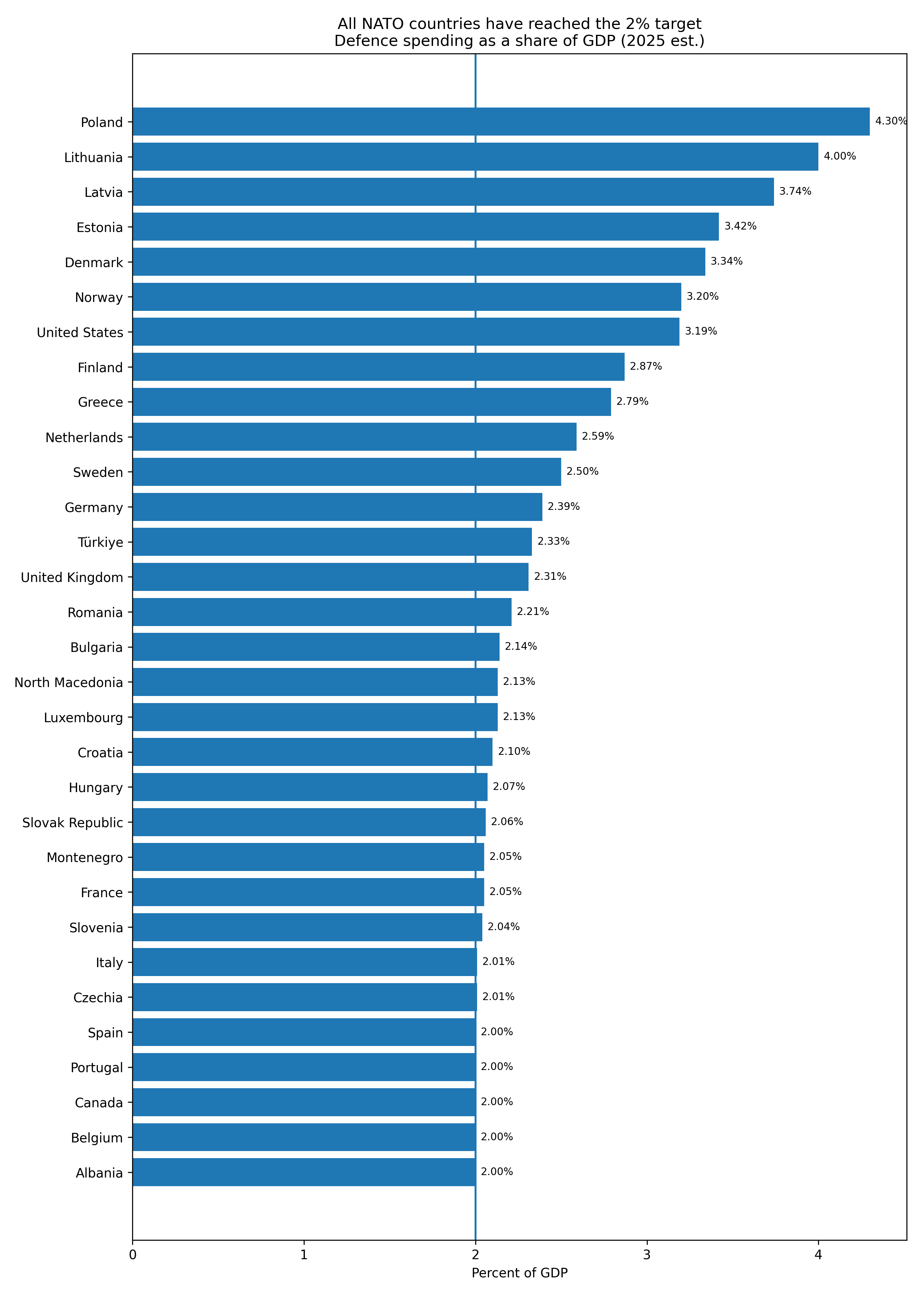
All of Nato’s members have met the alliance’s 2% of GDP defence spending target for the first time, pushing total military expenditure to a record $1.4 trillion, according to data reported by Euractiv on March 20.
The guidance that Nato members should spend 2% of GDP on defence was set at the Wales Nato summit in 2014, since the Nato summit in the Hague the level has been raised to 3.5% for purely spending on weapons and 5% for defence spending in general by 2035. Currently only Poland and three Baltic states are spending anything close to 5% of GDP on defence.
In the meantime, the rest of the alliance is catching up. Spending across the alliance rose from $1.3 trillion the previous year, reflecting a sustained build-up in military budgets following Russia’s invasion of Ukraine and growing concerns over long-term security commitments. The increase has been driven in large part by European allies and Canada, whose defence spending rose by 20% in real terms to $574bn.
That shift is starting to rebalance the alliance. Europe and Canada now account for about 41% of total Nato spending, although the US still provides the majority. Washington’s defence spending stands at 3.19% of GDP, below several eastern European members that have accelerated military investment more aggressively.
Poland recorded the highest share at 4.3% of GDP, followed by Lithuania at 4%, Latvia at 3.74% and Estonia at 3.42%. The concentration of higher spending among countries closer to Russia’s borders reflects a sharper perception of immediate threat.
A significant portion of the increase is being directed towards rearmament. Of the $574bn spent by Europe and Canada, 34% has been allocated to arms procurement, signalling a shift from personnel-heavy budgets towards equipment, munitions and industrial capacity.
Nato Secretary General Mark Rutte described 2025 as a “watershed” year for the alliance, as members moved collectively to meet a target first agreed more than a decade ago. He added that allies should now consider raising ambition further, calling for a move towards spending 5% of GDP by 2035 and a faster expansion of arms production.
The milestone comes as pressure grows on Nato to sustain higher levels of readiness over the long term, with defence planners warning that the current spending trajectory may need to be maintained well beyond the immediate conflict in Ukraine.
Unlock premium news, Start your free trial today.


