
Russia's ruling party claims 57.9% of the Duma vote, 20 points above the Kremlin's own pollsters


United Russia is heading for a bigger State Duma majority than it won in 2021, on a count running some 20 points above the Kremlin's own final polling.
With 90.43% of ballots processed, the ruling party had 57.86% of the federal party-list vote and led in 208 of the 225 single-member constituencies, TASS reported on September 21. That points to roughly 331 seats in the 450-seat chamber, well past the 301 a party needs to amend the constitution on its own.
The Communist Party had 13.84%, and the systemic opposition parties of the Liberal Democratic Party of Russia (LDPR) 8.9% and liberal-leaning New People 7.94%. Duma veterans A Just Russia, which is on the verge of being a non-systemic opposition party, was on 4.95% and falling - it stood at 5.23% when a third of precincts had reported and has lost ground with every tranche since, Meduza reported. If it finishes below the 5% barrier the Duma drops from five parties to four.
The long standing liberal non-systemic opposition party Yabloko, which has nevertheless been tolerated by the Kremlin as it has been a feature of Russian politics since the 1990s, was struck off the party-list ballot by the Supreme Court on August 10. Still, more than 100 of its candidates stood in single-member seats and the party urged supporters to spoil their party-list papers rather than back the four systemic opposition parties left on it.
Yabloko was the only party to campaign on an anti-war platform, but when it threatened to turn the general election into a referendum on the war, the Supreme Court barred its candidates from standing.
“Support” for United Russia has surged in the week of the poll. Both of the Kremlin's own pollsters had it in the 30s a week before polling opened - VTsIOM on 37.4% and FOM on 33%. The count is also eight points above the 49.8% United Russia was awarded in 2021, a result independent analysts said had been padded with 13mn-16mn fraudulent votes. On the commission's numbers, support for the ruling party has risen by eight points over a war that both pollsters had been recording as a drag on it.
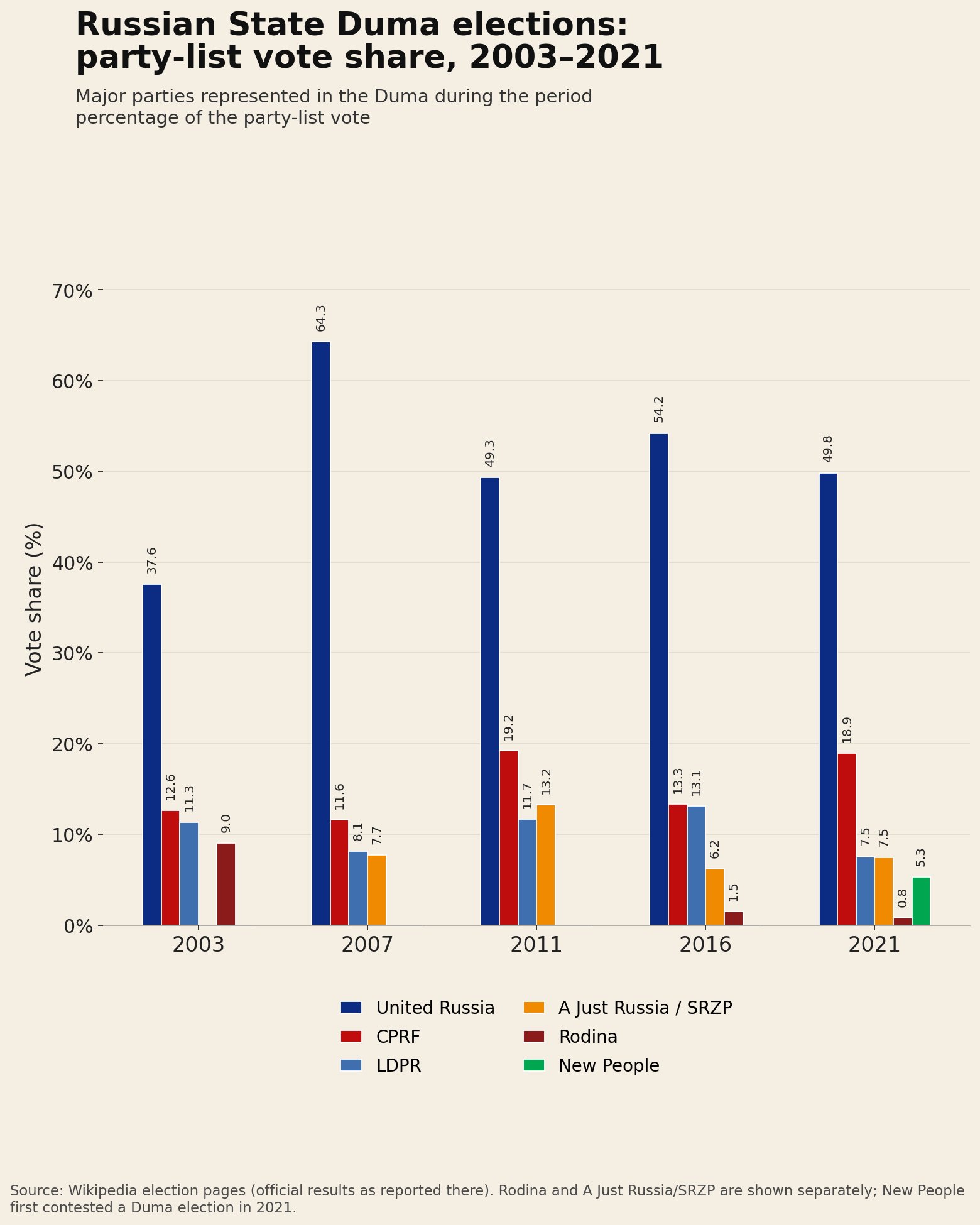
United Russia's party-list share has swung between 37.6% and 64.3% since 2003. A final 57.9% would be its second-best result in two decades.
The count outran the exit polls as well. VTsIOM put United Russia on 49.4% as voting closed and INSOMAR on 52.8%, both well below the figure the commission began publishing hours later.
This was the first time it was possible for the bulk of the population to vote electronically, after the 2021 elections introduced e-votes in only 17 regions. The change over is widely seen as ending any pretence of democracy and free voting as the 2021 elections highlighted the control the Kremlin has over the vote when the Communist Party (KPRF) win in Moscow was overturned overnight after the electronic votes were added to the tallies.
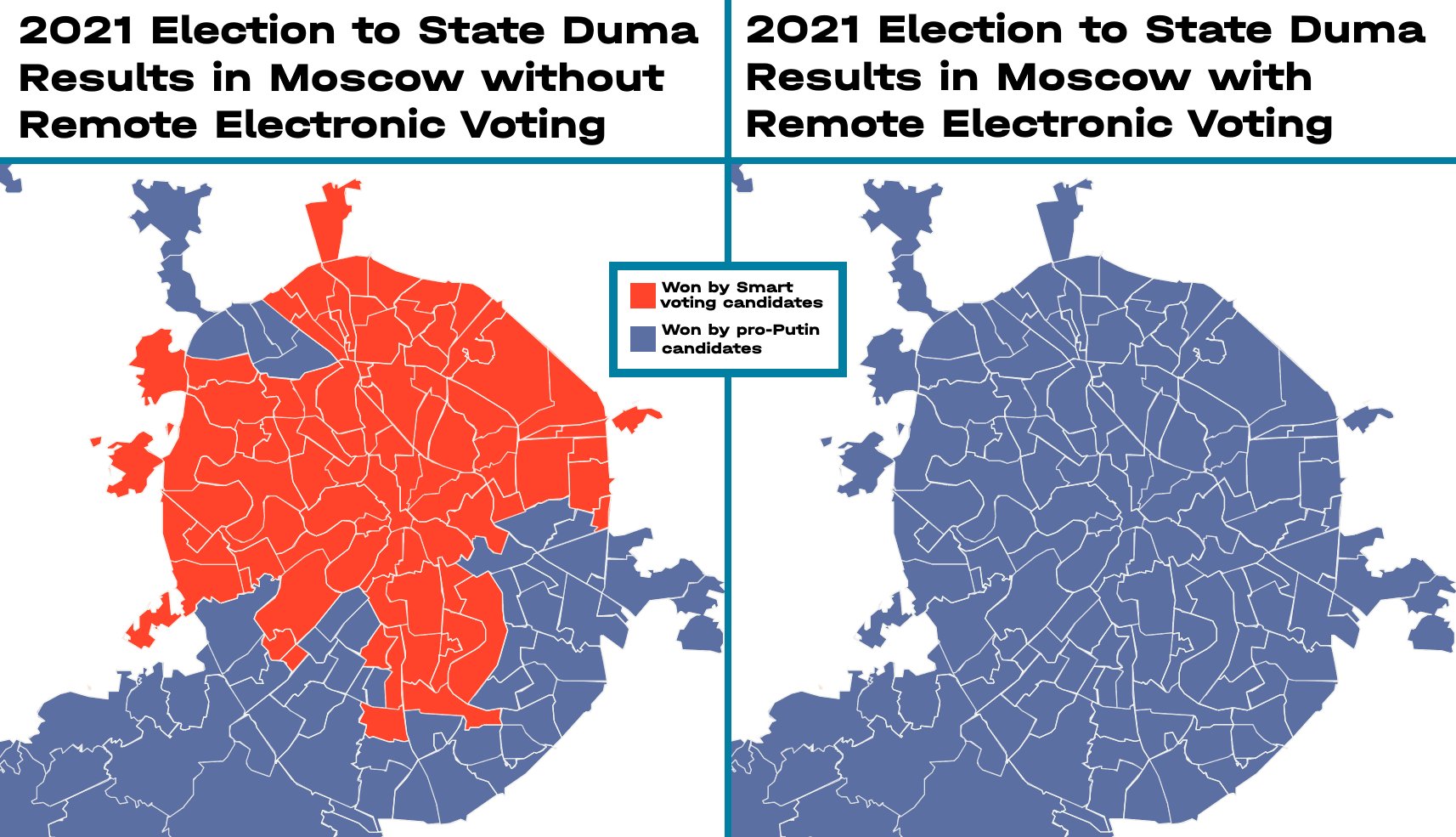
Moscow in 2021, with and without remote electronic voting: the online tranche reversed every constituency won on paper by Smart Voting candidates.
The Kremlin had spent the summer managing expectations downwards. United Russia's nationwide target was cut from 55% to 50% in June and the target for mid-loyalty regions from 50% to 45% in July, before the Presidential Administration raised them again in the closing weeks - to 47% in average regions and 52-53% where officials saw a higher degree of mobilisation, with a nationwide expectation of more than 50%, Meduza reported on September 8. Even the raised target is more than seven points below what has now been announced.
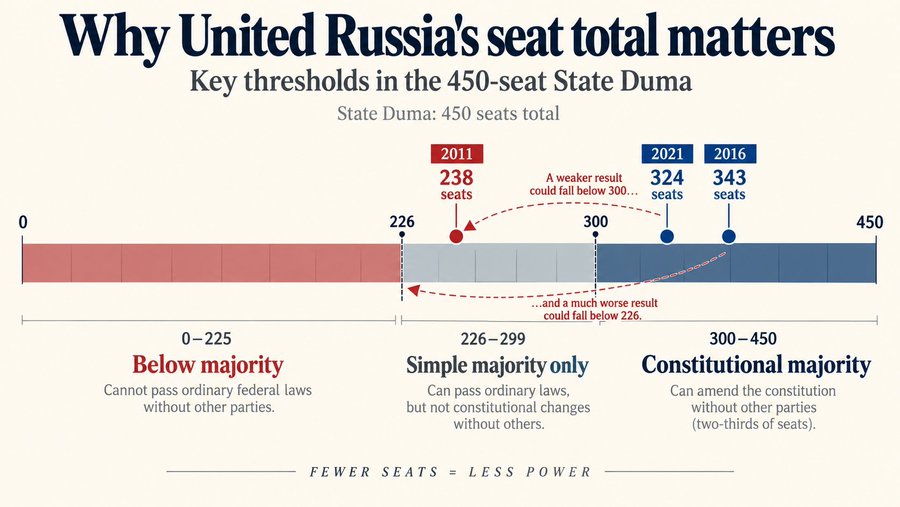
Why the seat total matters: 301 of 450 seats lets a single party amend the constitution without anyone else's votes.
Turnout was 56.66% by 20:00 on September 20, against 51.72% in 2021.
Having been robbed of nearly a quarter of the Duma seats in 2021, Communist leader Gennady Zyuganov rejected this year’s count as well as the KPRF has once again seen a lot of its votes stolen by Uniter Russia. He warned of a return to the “wild 90s” when the Duma was largely gridlocked by fractional fighting, saying his party would set its own copies of polling-station protocols against the official tally.
“The tables that have been shown on the screens here over the past three hours do not reflect any real trend or the true picture,” Zyuganov said, alleging that in Voronezh “all our observers were removed, completely illegally”. The Communists' 13.84% is five points down on the 18.9% they took in 2021.
However, as part of the systemic opposition, this is the KPRF’s job: to allow voters to blow off some steam at the obvious rigged nature of the system, without actually doing anything about it. Zyuganov failed to call for mass demonstrations following the obvious manipulation of the 2021 Moscow result and he is very unlikely to call for any drastic actions this time round either.
Just how deep the fix runs was demonstrated by two photographed polling-station protocols from the Babushkinsky constituency in Moscow that were literally next to each other in the same school on Glebovskaya Street that produced impossibly opposite results. At station 857, where observers were present, United Russia's Vladislav Gusev took 90 votes and finished third behind the Communist candidate Georgy Fedorov on 125 and the Greens' Yulia Kuznetsova on 102. At station 871, where the observer was refused entry according to the journalist who posted the protocols, Gusev took 675 against Fedorov's 24 and Kuznetsova's eight.
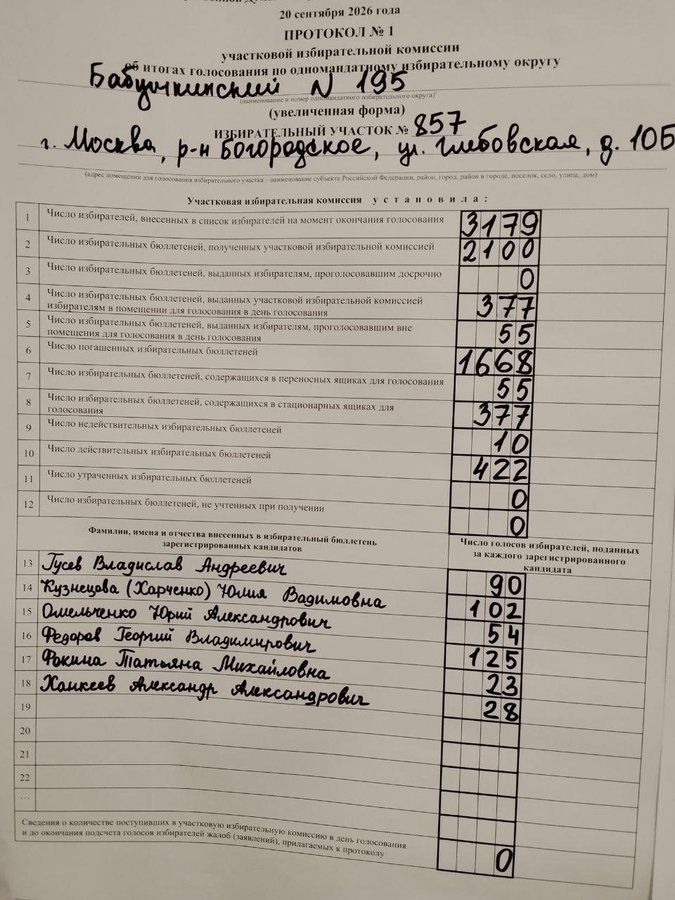
Station 857, Glebovskaya Street, Moscow: observers present, United Russia's candidate third.
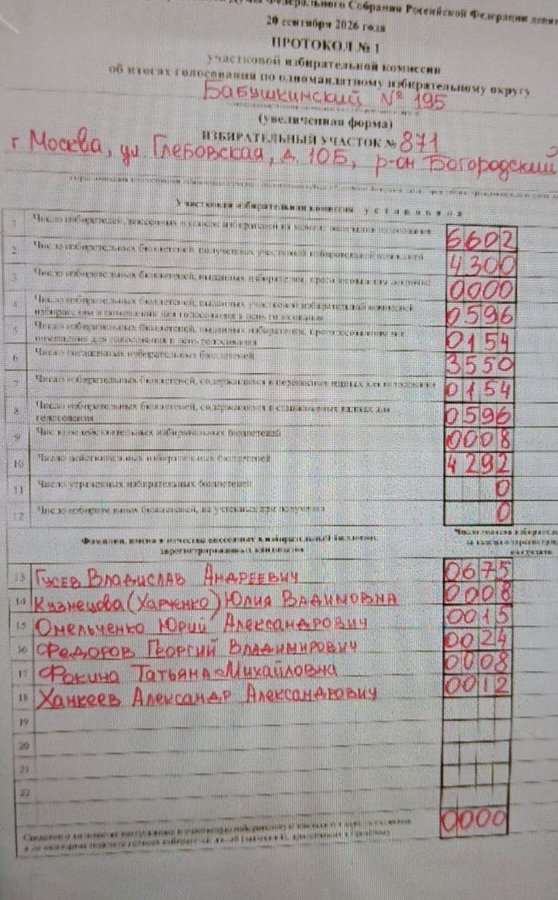
Station 871, the same address: the observer was not admitted and United Russia's candidate took 675 of about 742 votes cast.
The monitoring platform Vybory 2026 - nablyudaem vmeste! logged more than 900 complaints by 20:00 on September 20, about a third of them concerning observers being barred, removed or detained. The Prosecutor General's Office said it had recorded no serious violations of the law during the voting.
Remote electronic voting ran in 32 regions plus Moscow, covering 48.4mn eligible voters from a total of 111mn. Central Election Commission chairwoman Ella Pamfilova said the platform came under a “massive and intense” cyberattack from Ukraine from late on September 19 into the following morning but that voting was not interrupted, the Kyiv Post reported. Moscow's city election commission reported the same, and the digital development ministry claimed an attempted diversion on communications lines in the Far East. Putin complained that Kyiv was trying to interfere with the vote, but none of the claims was independently verified, and no evidence was offered linking any of them to Ukraine.
Wartime elections
The Kremlin is keen to carry out the vote to show that elections can be held in war time and have been playing up the theme as part of their rhetorical efforts to show that Zelenskiy’s government is illegitimate as he has repeatedly refused to hold elections and his presidential term officially expired last May. Ukraine’s constitution precludes holding elections while martial law is in effect.
The war lingered in the background as many Russians fear as soon as the poll is concluded Putin will launch a second mobilisation to flood the Donbas with fresh recruits and bring a swift end to the war. And those fears look real. Men who voted online began receiving notices on the Gosuslugi state services portal telling them they had been added to the military register, Agentstvo reported, citing a Moscow voter who was registered within hours of casting an electronic ballot. Yabloko said two observers working for a member of its federal political committee were handed summonses to report to enlistment offices.
Voting was held in occupied parts of Donetsk, Luhansk, Zaporizhzhia and Kherson, and Russia opened polling stations in Transnistria over Moldovan objections, after Chisinau summoned Russia's ambassador in early September.
Russia has never run the near-unanimous votes staged in North Korea, or the 70-90% results normal in Central Asia, and its federalism is part of the reason: closed republics deliver very large majorities while the big cities do not, so the federal total is assembled from very unequal local counts. The political scientist Julian Waller, writing on X on September 18, put it this way: “the general rule of thumb is that at the federal level, you can tack on roughly 15-20% of that as fraud.”
A Just Russia has sat in every Duma since 2007. It may not be in the next one. Yabloko first entered the State Duma in the December 1993 election, the first parliamentary election of the post-Soviet Russian Federation. The Yavlinsky–Boldyrev–Lukin bloc, which became Yabloko, won 33 seats. It remained a significant parliamentary faction for the Yeltsin-era. Yabloko failed to clear the 5% party-list threshold in 2023 at the start of the Putin-era, but four Yabloko candidates won single-member constituencies, which is the only representation it had until its total exclusion now.
Unlock premium news, Start your free trial today.


