Romania’s trade deficit shrinks amid subdued domestic demand


Romania’s trade deficit narrowed sharply in November as imports declined amid weaker domestic demand, while exports remained broadly stable, official data show.
Imports fell by 5.3% year on year (y/y) to €10.6bn in November, a month that traditionally marks the build-up of inventories ahead of peak retail sales. Exports edged down marginally by 0.1% y/y to €8.4bn, resulting in a trade deficit of €2.26bn, which was 21% smaller compared with November 2024.
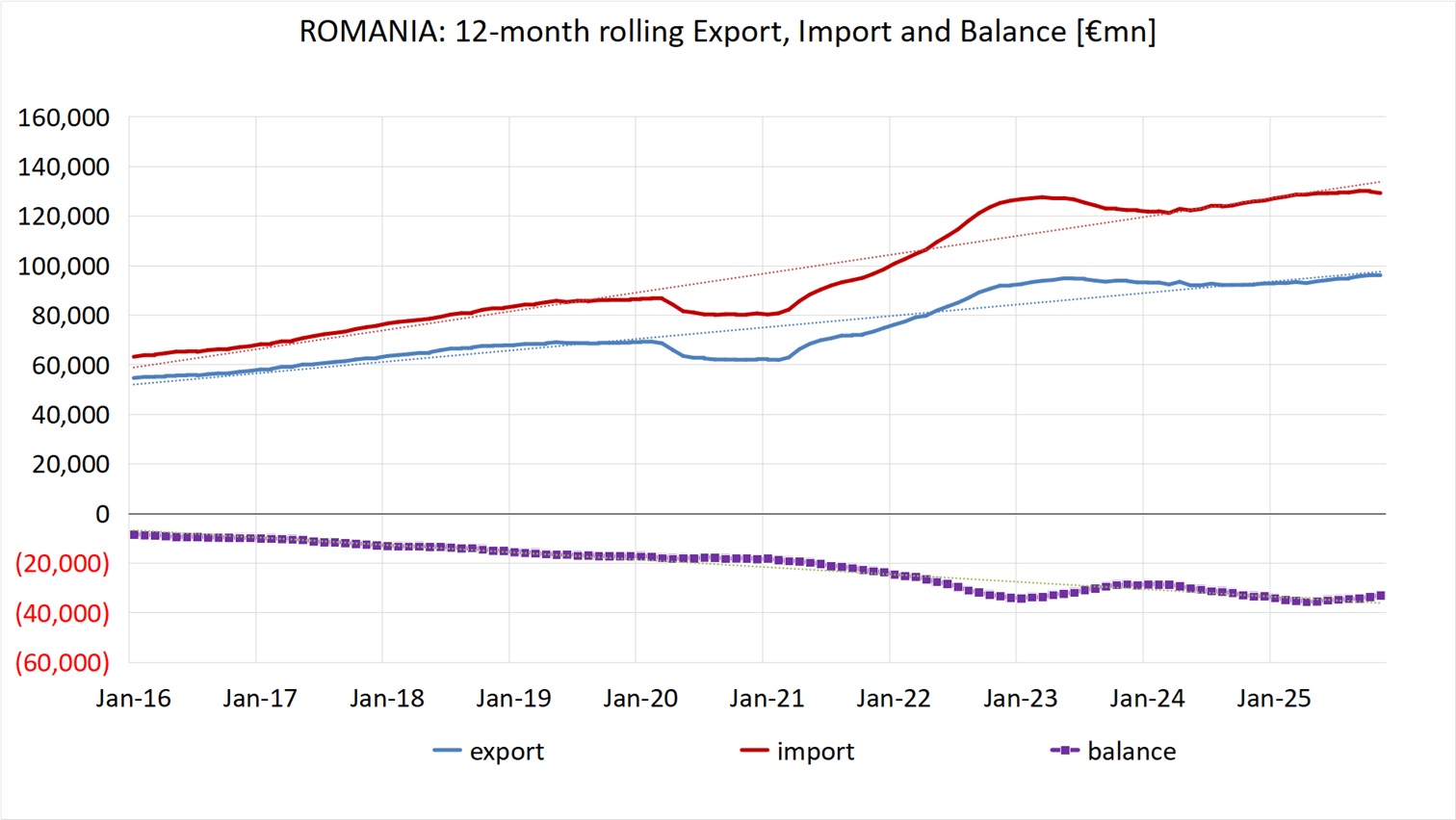
November marked the second consecutive month of a significant y/y improvement in the trade balance. In the 12 months to November, Romania’s cumulative trade deficit stood at €33.1bn (chart), equivalent to 8.8% of GDP, around 1.2% lower than in the previous 12-month period.
Measured against a higher nominal GDP, the deficit-to-GDP ratio has declined from 9.5% in the 12 months to November 2024 and from a peak of 9.8% in April 2025, when the trade balance began to improve amid weakening consumption demand.
Signs of subdued household spending were also visible in consumer surveys. A poll conducted by Avangarde in mid-December 2025 showed that 49% of respondents said they spent less or much less during the Christmas season compared with 2024, while 27% reported similar spending levels. Only 18% planned higher or much higher spending. The survey took place against the backdrop of consumer price inflation of around 10%, which increased the cost of maintaining the same consumption volumes.
Available retail data indicate that retail sales fell by 3%-4% following the inflationary shock in July and August, triggered by electricity price liberalisation and a VAT rate increase. Expectations of no public sector wage or pension rises, alongside weaker sentiment in the private sector, have further weighed on consumer confidence.
The National Commission for Strategy and Forecasting said in its latest projection, dated December 2025, that private consumption is expected to decline by 0.8% this year, following a 0.1% contraction in 2025. The institution forecasts imports to grow by just 1.7%, about half the pace recorded in 2025, as domestic demand remains contained.
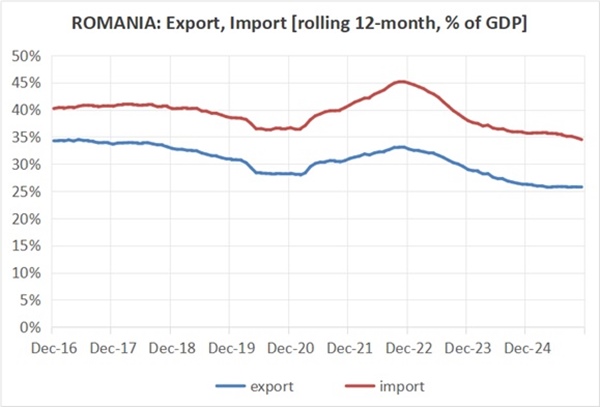
Under a broader perspective, Romania’s exports and imports have declined as a share of GDP over the past decade (chart2), but the underlying causes remain to be investigated. After subdued foreign trade during the pandemic and a sharp rise in exports and imports driven by price effects following the war in Ukraine, exports fell from nearly 35% of GDP in 2016 to around 26% currently. The import-to-GDP ratio also declined, from over 40% in 2016 to about 35% at present.
One interpretation is that the local economy is covering a larger share of domestic demand, while a less favourable explanation points to faster price growth in non-tradable sectors, particularly services.
Regardless of the underlying drivers, the trade deficit widened from around 6% of GDP in 2016 to 8.8% in the 12 months to November 2025. The gap has, however, narrowed since April 2025, reaching one of its lowest levels in the past four years, as restrained consumption demand continues to support an improvement in Romania’s external balance.
Unlock premium news, Start your free trial today.