
Putin attempting knockout blow by freezing Ukraine into submission


Over the last week, Russia has launched a massive barrage of drones and missiles against not just Ukraine’s generating capacity, half of which has already been destroyed, but against the power grid that distributes what power is still produced.
City after city is being blacked out in the midst of the coldest winter in a decade and the Soviet-era apartment blocks that dominate accommodation in Ukraine are starting to become uninhabitable. A humanitarian crisis is looming that could spark a fresh wave of millions of refugees fleeing life-threatening sub-zero temperatures in their homes.
The attack comes as the US-sponsored ceasefire talks appear to stall. US President Donald Trump and Putin were hoping a deal could finally be struck at the Mar-a-Lago meeting on December 28, but without concrete security guarantees by the US and Europe for a post war regime, Zelenskiy refused to sign off.
Now Putin is playing his trump card and applying maximum pressure as Ukraine’s lack of men, money and materiel is reaching acute proportions. The US has withdrawn its financial support and demanding that the EU pay for any weapons at a time when Europe has no money to spare. At least 100,000 soldiers have deserted from the Armed Forces of Ukraine (AFU) and the conscription drive is failing to find replacements. Putin has had the ability to turn the lights off and force Ukraine to capitulate since the beginning of the current campaign, but he has waited until now in the hopes of pushing the resilient Ukrainians over the edge into accepting capitulation on Russia’s terms. This war has not just been a war of military attrition, but psychological attrition too.
Russia began targeting Ukraine’s thermal and extensive hydropower generating capacity at the start of 2023, but now it has been scaled up and is taking out the grid and plunging city after city into freezing darkness.
Ukraine’s power sector is made up of two halves: the thermal and hydropower (accounting for half the pre-war output) on one side and the nuclear power stations on the other (up to 60% of the total output as of 2024). Of the 15 reactors available pre-war, only nine are still operational with a combined capacity of 7.7GW. That is just enough to keep the country going through the winter, although emergency power regimes and frequent black outs have plagued the country since Russia switched to a missile war last summer. What is happening now is even that meagre supply is being shut down.
Temperatures dropping
When the attacks on power infrastructure started in earnest just over a week ago, temperatures in apartment blocks in Kyiv were reported to have fallen to 13°C-15°C, but as the week worn on they continued to plummet and were 2°C by January 16 and fell to -2°C in some apartments by January 18 – life-threateningly cold, according to anecdotal reports.
“Today, journalists from Hromadske visited an apartment in Kyiv where the indoor temperature was -5°C/23 ∘F. That's a temperature at which a person can fall asleep and never wake up,” posted Iulia Medel, Ukrainian President Volodymyr Zelenskiy former press secretary on January 17. “Now, living there has become simply impossible. Yet some people remain.”
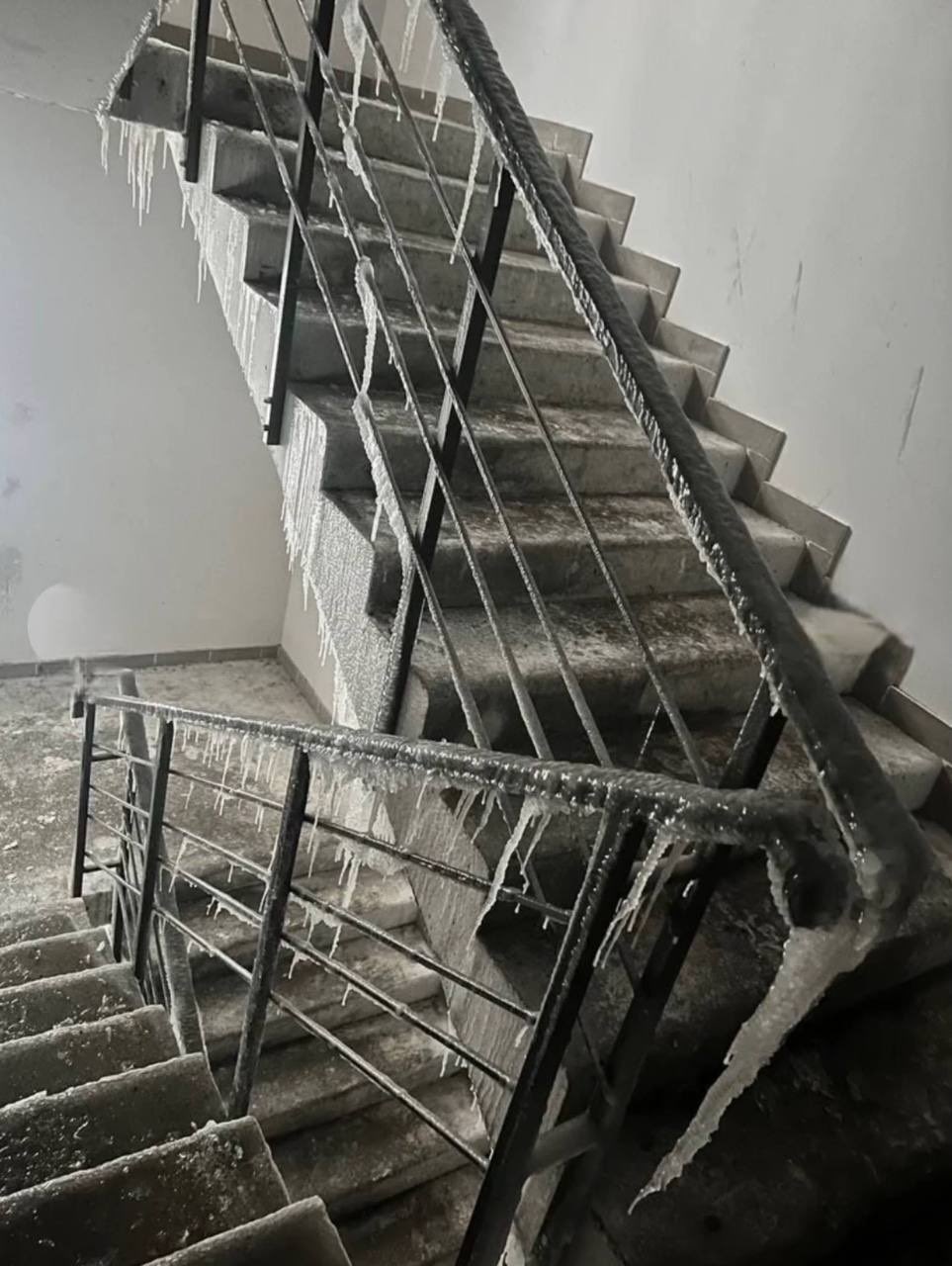
Tempratures in some apartments are now so low that ice is forming inside.
Kyiv’s most vulnerable citizens are in the firing line: pensioners, the disabled, and those with small children who have nowhere else to go.
Zelenskiy said last week that hundreds of thousands of homes were without power or heat. Kyiv mayor Vitali Klitschko said on social media that power had been restored to 6,000 apartment blocks in the capital by January 18 following the recent attack after half the city was blacked out, but 50 buildings remain in the dark and the rest on deuced supplies. Klitschko said the city of 3.6mn people requires 1,700 megawatts of electricity, but only about half is currently available.
Utility and emergency services were working around the clock to restore more, but they are working against a relentless ongoing barrage of drones and missiles that have overwhelmed the city's air defences. The situation in the regions is worse.

Ukraine is currently suffering from the coldest January in a decade.
Local economies in shutdown
Local city-economies are already starting to shut down. Walking down Khreshchatyk in central Kyiv for most of the last two years and the sound of petrol-fuelled generators fill the air as small businesses power their shops during the frequent power cuts, but now the scale of the onslaught is so great and the temperatures so-low that the limited generating power these small generators can provide has been overwhelmed. Shops and services are closing down.
“Businesses are shuttering en masse: salons show frozen manicure tools encased in ice, cafes tally astronomical costs for generators and batteries (which thieves often steal, necessitating extra security),” Medel said in a social media post from Kyiv.
As bne IntelliNews reported, supermarkets have also closed as their refrigerators either go offline or are broken by the constant power flip flops. Essentials like bread are becoming hard to find and food at home is dwindling that will only exacerbate the growing humanitarian crisis.
Energy Ramstein
Zelenskiy has declared an “energy emergency” and is sounding increasingly desperate (his normally black beard has started to turn grey) as he calls on his European allies to “open the warehouses” and supply Ukraine with more air defence ammo “immediately.”
“Our intelligence reports that Russia is preparing new massive attacks. We are speaking frankly to our partners—both about air-defence missiles and the systems we need so much. Supplies are insufficient. We are trying to speed things up, and it's crucial that our partners hear us,” Zelenskiy said in a video post on January 16.
He said tens of thousands of people from utilities and municipalities were working to restore power. He went on to call for an “Energy Ramstein” to deal with the mounting crisis. The first Ramstein meeting of Ukraine with its European allies in the first year of the war marked a pivotal point. Russia invaded a few months earlier and against all expectations was rebuffed by the Armed Forces of Ukraine (AFU). At the first Ramstein meeting the allies agreed to arm Ukraine in its defence against Russian aggression. Zelenskiy is saying Putin’s attack on Ukraine’s energy grid is an equally existential threat to Ukraine’s freedom that requires an equally significant response by Europe.
In the meantime, Ukraine is attempting a tit-for-tat retaliation, attacking power and substations along the Russian border. More than 200,000 homes in Russian-occupied southern Ukraine were left without power following a Ukrainian attack, Moscow authorities said January 18. Russian cities across the border are also being hit with Ukrainian drones. However, with the Ukrainian drones vs Russian missiles mismatch, the pain that Ukraine can inflict on Russia is a fraction of what Russia can inflict on Ukraine.
“Our leadership continues to blame Putin and the West—for not providing enough missiles—and keeps confirming new and further strikes deep inside Russia, which have nowhere near the same impact as those felt in Ukraine,” says Mendel.
Substations targeted
The Zaporizhzhia nuclear power plant (ZNPP), with 6GW capacity, the largest in Europe, is currently under Russian control and not providing power to the country. A brief ceasefire was called on January 17 to allow the repair of a 330kV powerline to the station. The NPP needs a minimum amount of power to keep the reactors stable, even though they were shut down last year, to prevent a nuclear disaster. The Kremlin is being careful enough to prevent a meltdown at one of Ukraine’s four working NPPs, and while it can’t target the reactors directly, it is keeping their output off the market by taking out the distribution system.
As bne IntelliNews reported, Ukraine’s power grid relies on some 70 ultra-high voltage 750kV substations that are the nodes that provide power to whole cities and act as inter-rẹ̣gional connectors. While Russia has blown up much of the non-nuclear generating capacity, until now it has largely ignored these substations. In addition, there are thousands of smaller 330vK substations which provide power more locally.
Not anymore. The first two to be hit were a substation in Sumy in October and then Odesa’s 750kV substation in December, blacking out the city for a week.
The details of exactly what Russia is targeting in the current campaign remain vague, but multiple reports say substations are being hit, although it is not clear how many, if any of the larger 750kV substations are being hit, or if Russia is holding itself to hitting the smaller and easier to repair, 330kV substations. In any case, just destroying one of the smaller substations is enough to plunge entire regions of a city like Kyiv into darkness.
Energoatom corruption
The substations for the NPPs remain wide open to missile attack. Previously, the CEO of Ukrenergo, Volodymyr Kudrytskyi, the state utilities company for the non-nuclear power, independently raised over $1bn from international partners for energy investments, separately from what the state raised, which was used to build some 70 concrete bunkers to protect crucial substations. Last week, Shmyhal boasted that these bunkers had resisted multiple missile strikes and remained operational.
However, the plan to build similar bunkers for the substations distributing power from the NPPs never happened thanks to the $100mn kickback scheme carried out by Zelenskiy close associate Timur Mindich as part of the Energoatom corruption scandal.
Russia has taken advantage of this lacuna by destroying the thermal and hydro generating capacity. But while it can’t target the NPPs directly for obvious reasons, it doesn’t have to as its key substations remain completely unprotected. If Putin’s gambit to end the war by blacking out Ukraine is successful, the Energoatom corruption scheme will bear the brunt of the responsibility for Ukraine’s defeat.
A sign of how corrupt Ukraine has become, Kudrytskyi was not praised for his foresight and energy; he was removed from office after he complained to then Energy Minister Herman Halushchenko about the lack of progress in protecting Energoatom’s substations, and is currently facing corruption charges for a fencing scheme that never happened. Halushchenko was one of the key beneficiaries of the Energoatom scam and has since quit after he was caught up in the National Anti-Corruption Bureau of Ukraine (NABU) investigation but is not facing any charges. Mindich fled the country and is now living in luxury in Israel.
Nato copycat
Energy Minister Denys Shmyhal called the attack on Ukraine’s power sector in the depths of the coldest winter in a decade an act of “genocide” that is clearly against the Genevra Convention. The problem is that Nato used exactly the same tactics in the Yugoslav war, destroying 80% of Serbia’s generating capacity.
In statements at the time, Nato justified the attacks, saying that power was an essential “military” input and so a legitimate military target – the effect on civilians was simply acceptable collateral damage. Moreover, attacks on utilities to blackout an adversary’s country are also a standard part of US military doctrine.
Nato’s Deputy Assistant Secretary General for Emerging Security Challenges, Jamie Shea said at a briefing in May 1999: “Yes, I'm afraid electricity also drives command and control systems. If President Milosevic really wants all of his population to have water and electricity all he has to do is accept Nato's five conditions and we will stop this campaign. But as long as he doesn't do so we will continue to attack those targets which provide the electricity for his armed forces. If that has civilian consequences, it's for him to deal with but that water, that electricity is turned back on for the people of Serbia."
The Nato bombing campaign has become a major embarrassment for the allies. This statement has been on the alliance's website for over 25 years, but suddenly it has disappeared. Nato has taken the statement off its website, although archived copies remain widely available.

Unlock premium news, Start your free trial today.


