Private consumption shrinks after August fiscal package in Romania


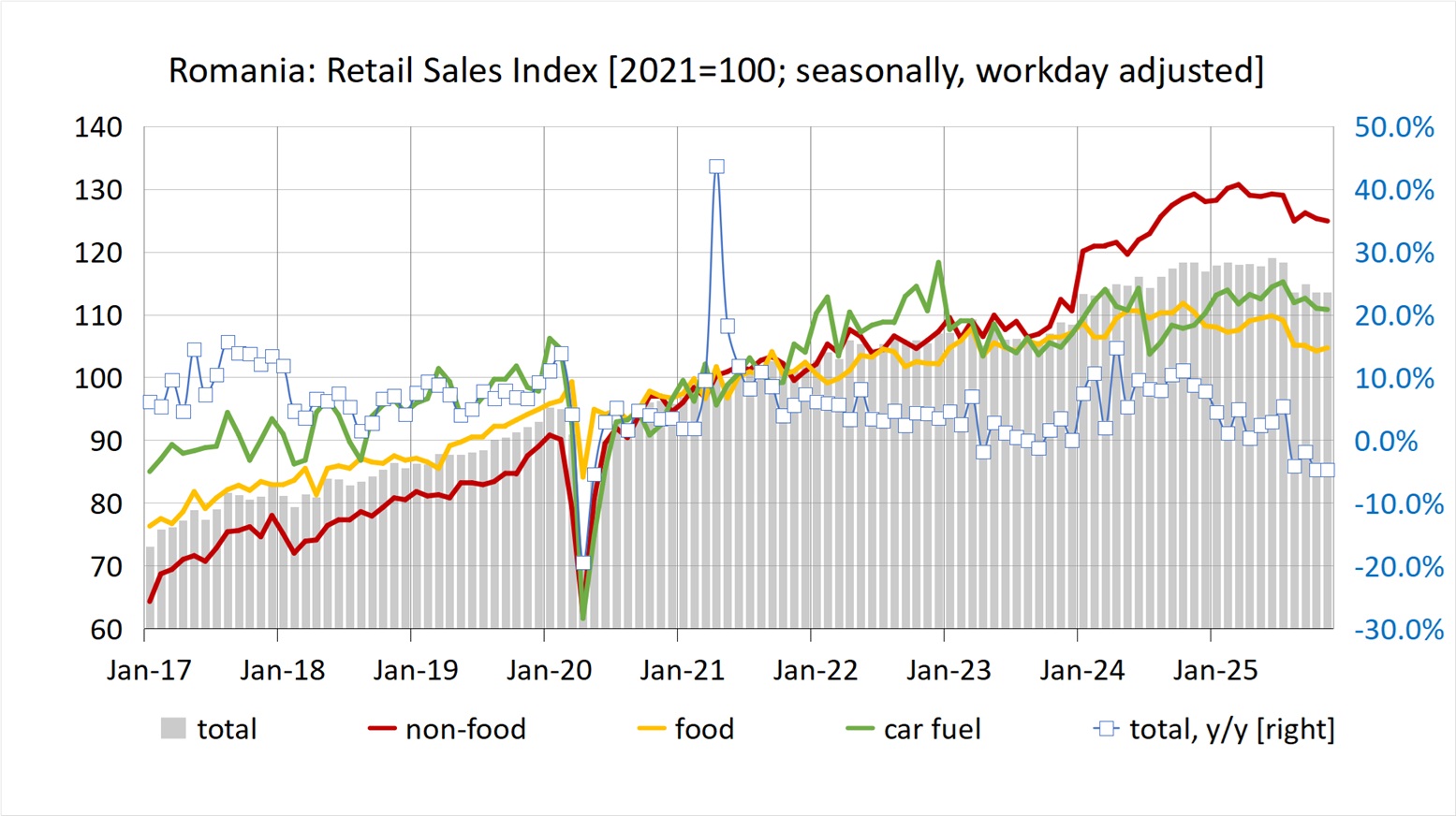
Private consumption in Romania (chart) contracted by an estimated 3-4% in the months following the August fiscal corrective package, as higher indirect taxes and rising prices weighed on household demand, according to the retail sales data from the national statistics office INS.
The retail sales volume index fell by 4.7% y/y in November, marking the fourth consecutive month of annual decline. In seasonally adjusted terms, retail sales remained unchanged from October, indicating that consumption has stabilised at a lower level after the summer shock, according to INS data.
Inflation accelerated sharply in mid-2025, driven by the deregulation of the electricity market in July and a VAT increase from 19% to 21% in August. Consumer prices in the July–November period were 5.9% higher than in the first part of the year. Non-food goods recorded a steeper rise of 7.6%, while food prices increased by a more moderate 3.7%, reflecting government controls on basic goods.
The erosion of real incomes has been compounded by flat wages in the public sector and cautious pay policies in the private sector. These factors are expected to keep consumer confidence subdued and retail sales weak through 2026, despite expectations that inflation will ease later this year, with upside risks linked to further price liberalisation in the spring.
Overall, retail sales volumes in August–November were 3.6% lower than the average recorded in the first seven months of the year in seasonally adjusted terms, and 3.9% below levels seen in the same period of 2024. Food sales recorded the sharpest decline, falling by 5.9% y/y, while sales of non-food goods and automotive fuels decreased by less than 3% y/y.
The social impact of the fiscal measures has been felt most acutely by low-income households, whose spending is concentrated on food and other essentials, with limited scope to cut discretionary (largely non-food) purchases.
The recent contraction follows an exceptional twelve-month period in which private consumption reached a record high. Average retail sales have now returned to levels last seen in early 2024, a period marked by an unusual surge in (seasonally adjusted) non-food sales, which jumped by 8.6% m/m in January 2024, suggesting a possible methodological break in INS data. The retail sales, particularly the non-food sales, kept rising through the second part of 2024, pushing the overall retail sales index to a plateau before the 3%-4% plunge occurred in July-August 2025.
Unlock premium news, Start your free trial today.