
OECD raises US growth forecast to 2.2% as global economy weathers energy shock


The OECD has raised its 2026 US growth forecast by 0.2 percentage points to 2.2% and its global outlook to 2.9% as AI investment cushions the Middle East energy shock.
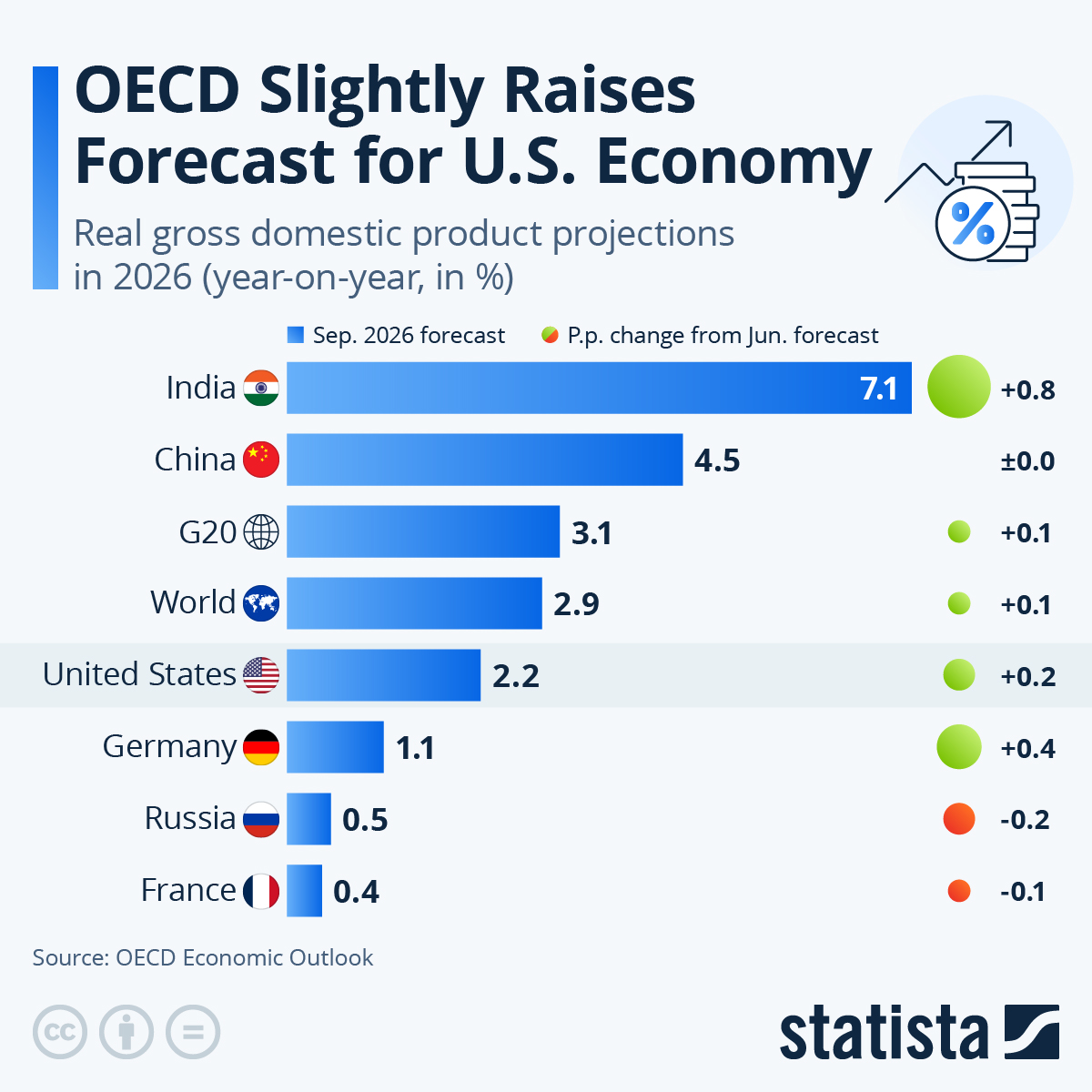
Source: Statista/OECD
World growth is projected to edge up to 3.0% in 2027, the Paris-based organisation said in its OECD Economic Outlook, Interim Report September 2026: Weathering Successive Shocks, published on September 23. The 2026 world and G20 forecasts were each raised by 0.1 percentage points (pp) from the June Economic Outlook, with G20 growth now seen at 3.1% this year and 3.0% next.
The upgrades mask a darker quarterly profile. The OECD says the commodity price shock is proving more persistent than it assumed in June, and it expects headwinds through the end of 2026 and early 2027 as inflation erodes household purchasing power and central banks raise rates. "Global economic prospects remain heavily dependent on whether a durable resolution to the Middle East conflict is achieved," the report says, adding that energy prices have recently risen again amid intensified disruption to Gulf production and exports.
Global growth slowed to an annualised 2.6% in 1H26 from 3.6% in 2H25. Sizeable oil inventories, extra supply from producers outside the Gulf and government support measures softened the blow, while spending on data centres and technology equipment lifted GDP in the US, Canada and Australia and boosted exports from chipmakers in Korea, Japan and China.
Advanced economies
US growth is projected at 2.2% in 2026 and 2.1% in 2027, the latter up 0.3pp, with strong AI-related investment partly offset by weaker consumer spending as purchasing power declines, labour force growth softens and household savings run down. The OECD expects one more Federal Reserve rate hike in 4Q26, taking the federal funds target range to 4-4.25%, where it would stay through 2027. US headline inflation is forecast at 3.6% this year, easing to 2.6% in 2027.
The euro area forecast was raised by 0.2pp to 1.0% for 2026 and cut by 0.2pp to 1.0% for 2027. Germany's 2026 forecast was lifted by 0.4pp to 1.1% on a recovery in exports, while France's was cut by 0.3pp to 0.4%. Spain remains the eurozone's strongest large economy at 2.6%, and Italy is forecast at 0.9%. Euro area inflation is seen at 3.0% in 2026 and 2.9% in 2027, 0.5pp higher than in June for next year, partly because of the steep rise in gas prices.
The UK is forecast to grow by 1.1% in 2026 and Japan by 0.8%, while Korea received the largest upgrade among advanced economies, 1.1pp to 3.7%, on strong industrial production and exports. Canada's forecast was cut by 0.3pp to 0.9% as new US tariffs weigh on some industries.
Emerging markets
Growth in the G20 emerging economies is projected to stay broadly stable. India received the biggest upgrade among G20 emerging economies, 0.8pp to 7.1% for the fiscal year 2026-27, after strong momentum earlier in the year, although the OECD expects reduced purchasing power to slow growth in the second half and forecasts 6.5% for FY2027-28. India is also expected to raise interest rates temporarily to offset stronger inflation.
China's forecast is unchanged at 4.5% for 2026, down from 5.0% in 2025, easing to 4.2% in 2027 as rising inflation weighs on consumption and the government's "anti-involution" campaign against excess capacity curbs investment. Indonesia's 2026 forecast was raised by 0.5pp to 5.2%, helped by improved terms of trade, with 5.1% expected in 2027.
Turkey was one of the few G20 economies to be downgraded, with its 2026 growth forecast cut by 0.4pp to 2.7% and its 2027 forecast by 0.2pp to 3.6%. The OECD also sharply raised its Turkish inflation projections, to 31.5% for 2026 and 24.7% for 2027, up 3.1pp and 6.4pp respectively, although it still expects rate cuts in Turkey as inflation moderates.
Russia's growth forecast is unchanged at 0.5% for 2026, with 2027 cut by 0.2pp to 0.6%. Russian inflation is projected at 6.5% this year and 6.0% next, the latter 1.4pp higher than in June.
Brazil's 2026 forecast was raised by 0.4pp to 2.0%, with the central bank having cut its policy rate by more than 1pp since March from a very restrictive level, while South Africa is forecast to grow by 1.2% in 2026 and 1.3% in 2027, the latter cut by 0.3pp. Mexico's 2026 forecast was lifted by 0.7pp to 1.5% on tech-related production, while Argentina's was trimmed to 2.6%. Saudi Arabia suffered by far the deepest cut, 5.0pp, and is now expected to contract by 1.8% in 2026 as the conflict hits Gulf output, before rebounding by 4.1% in 2027.
Inflation and risks
G20 headline inflation is projected to rise from 3.4% in 2025 to 4.1% in 2026 before easing to 3.6% in 2027. The forecasts assume energy prices follow futures markets, with Brent crude peaking at an average of $105 per barrel and Dutch TTF gas at €82 per MWh in 4Q26, before easing to averages of $85 and €60 in 2027. The assumed gas price path is around 60% higher than in June. European gas stocks are at the lowest level for the time of year in more than 15 years, and global observed oil inventories were some 507mn barrels lower in August than in February.
The OECD warns that renewed or longer energy disruption, a very strong El Niño - which the report says the US National Oceanic and Atmospheric Administration puts at a 95% probability for October-December - and a further rise in long-term bond yields or disappointing returns on AI investment could all hit growth. Its illustrative downside scenario combining higher energy and food prices, energy shortages and a 15% equity market fall would cut global growth by 0.7pp in 2027 and add 1.1pp to global inflation. On the upside, a 10% fall in oil and gas prices from 4Q26 would add 0.1pp to growth next year.
Long-term sovereign bond yields are at their highest in 15 years or more in most major advanced economies, driven by fiscal concerns and heavy bond issuance by AI companies, and the OECD urges governments to keep energy support targeted and temporary while setting out credible multi-year plans to stabilise debt.
Unlock premium news, Start your free trial today.


