
Iran suspends general aviation and VFR flights in new airspace directive


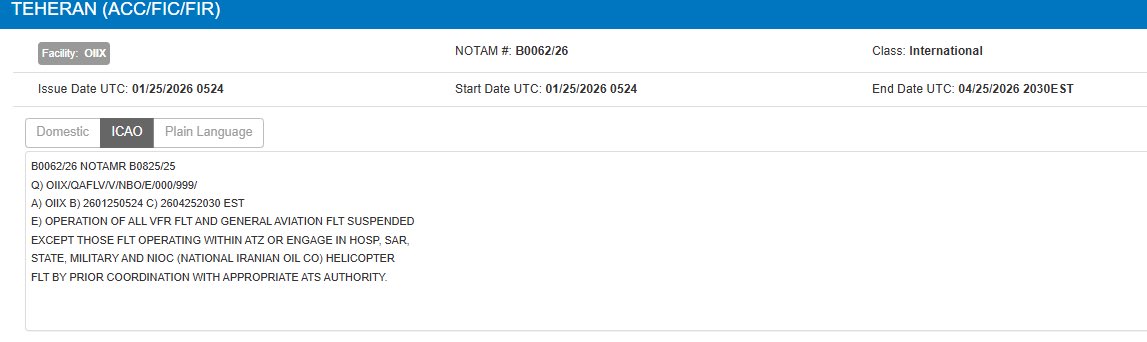
Iran has suspended all visual flight rules (VFR) and general aviation operations across the country from January 25 until April 25, according to a Notice to Airmen issued by Tehran's air traffic control authorities.
Visual flight rules (VFR) are typically used by private and recreational aircraft operating at low altitudes, meaning regular commercial air traffic is not affected at this time, as they generally operate under instrument flight rules (IFR).
The NOTAM (Notice to Airmen) B0062/26, issued on January 25 at 05:24 UTC for Tehran's OIIX facility, states that "operation of all VFR FLT and general aviation FLT suspended" for a three-month period ending April 25 at 20:30 EST.
European and North American airlines have moved quickly to cancel services to key regional hubs, including Tel Aviv, Tehran, and cities across Saudi Arabia, leaving thousands of passengers facing uncertainty.
The suspension includes exceptions only for flights operating within air traffic control zones or engaged in hospital, search and rescue, state, military and National Iranian Oil Company (NIOC) helicopter operations that receive prior coordination with appropriate air traffic control authorities.
The unprecedented closure to most civilian aviation comes as the US has deployed what President Donald Trump described as an "armada" of warships to the Persian Gulf, including the aircraft carrier USS Abraham Lincoln and a submarine armed with 150 Tomahawk cruise missiles in the Gulf of Oman.
Dutch budget carrier Transavia has cancelled all flights to Dubai and suspended operations over Persian Gulf airspace due to geopolitical tensions in the region, the airline announced on January 24.
KLM Royal Dutch Airlines announced an indefinite suspension of all flights to Tel Aviv, Dubai, Riyadh, and Dammam. In a statement, the airline cited "security considerations" for its decision to completely avoid airspace over Iran, Iraq, and Israel. Lufthansa Group, including Austrian, has extended its flight suspension to Tehran through March 28. The group has also restricted operations to Tel Aviv and Amman to daytime hours only, cancelling all overnight services until the end of the month.
Air France has adopted a fluid approach, temporarily pausing flights to Dubai, Tel Aviv, and Saudi Arabia over the weekend. While some Dubai services resumed on January 25, the carrier warned that the situation is being monitored in "real-time" and further abrupt cancellations are possible.
United Airlines and Air Canada have cancelled flights to Tel Aviv for the weekend of January 24–25. British Airways, Wizz Air, and Finnair have altered flight paths to bypass Iranian and Iraqi airspace entirely.
Emirates and flydubai continue to operate their core schedules but have been forced to cancel specific routes to Iranian cities, including Tehran and Isfahan.
Unlock premium news, Start your free trial today.


