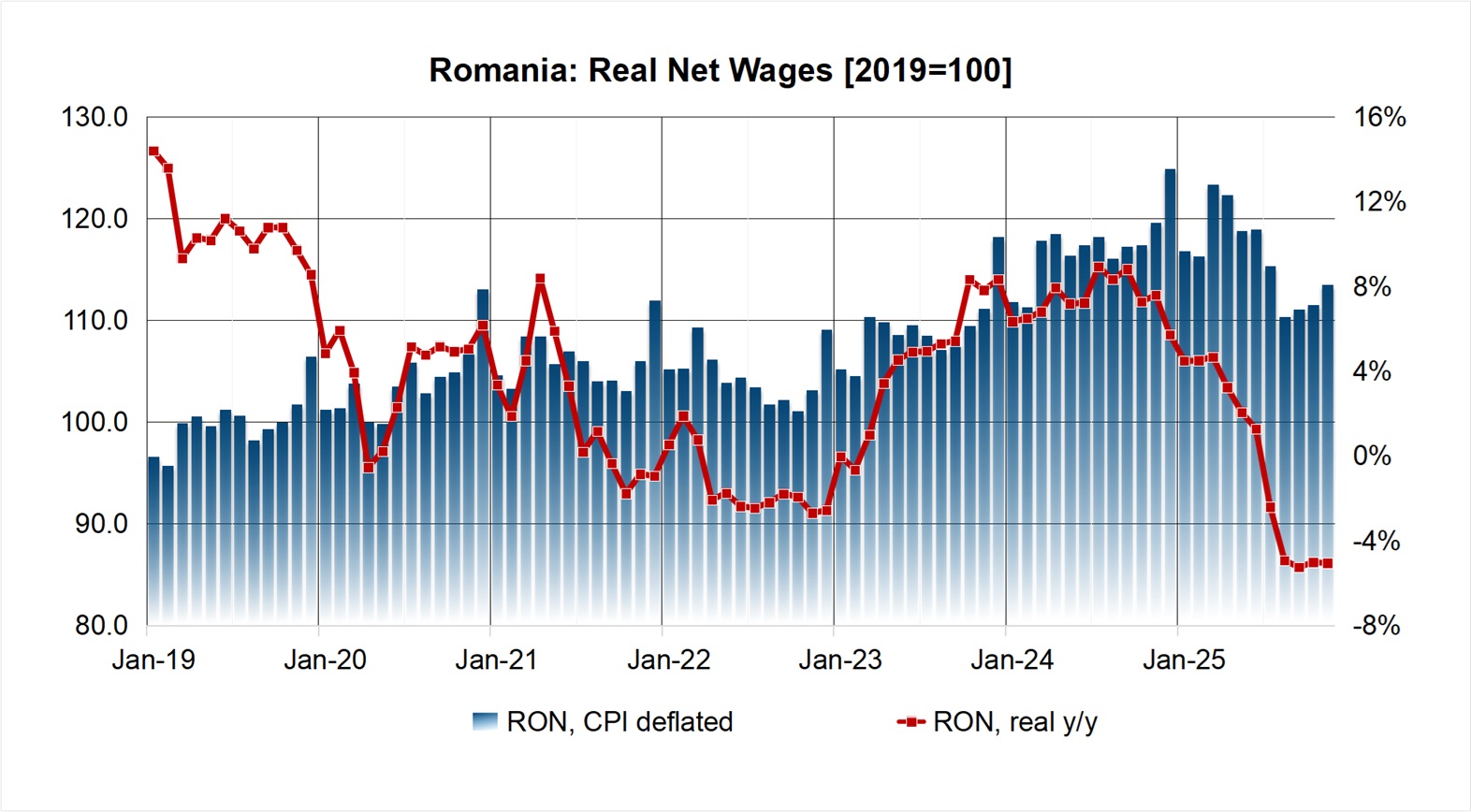
Inflation in Romania erodes real wages by 4.5% in June-November


Average net wages in Romania (chart), expressed in real terms, fell by 4.5% between June and November 2025, following a sharp mid-year inflation shock triggered by electricity price liberalisation and a value-added tax increase, according to data published by the national statistics office INS on January 16.
INS data showed that real wages plunged by 7.2% in July–August, when consumer prices jumped by 4.8% over the two months. This was followed by a partial recovery of 2.9% in September–November, as consumer price growth slowed to 1.3% over the period and wages rose in nominal terms, in some sectors. By November, the average real wage remained below its June level, although the pace of decline had reversed and monthly dynamics turned slightly positive.
The squeeze on household incomes was reflected in consumer demand. Retail sales volumes contracted by around 3%–4% compared with levels recorded before the July–August price shock, according to INS data. The moderation in demand is expected to support a slowdown in inflation in the coming quarters.
Headline inflation, which was close to 10% at its recent peak, is projected to decline sharply in July–August this year on base effects and reach 3.7% y/y by the end of the year, according to the latest forecast published by the National Bank of Romania.
The wage correction also affected broader macroeconomic indicators. The share of gross wages in gross domestic product fell to 37.4% in the third quarter, after peaking at the unsustainable level of 41% in the fourth quarter of 2024. This compares with a (sustainable) range of 35%–37.5% observed over previous years, INS data showed.
The National Commission for Strategy and Forecasting CNP expects real wages to decline by a further 0.9% y/y in 2026, following an estimated contraction of 1.1% y/y in 2025, according to its Winter Forecast. The wage share in GDP is expected to continue adjusting as a result, further boosting the country's competitiveness.
From a longer-term perspective, INS data indicate that real wages as of November returned to levels seen in late 2023 and early 2024, before expansionary wage measures adopted during the 2024 electoral year. Over the two years to November 2025, the average net wage increased by 2.4% in real terms, with uneven outcomes across sectors.
Real wages rose by 2.1% in manufacturing and by 2.8% in healthcare, but contracted in other budgetary sectors (administration, education), while pay in the HoReCa sector increased by 13% on a low base. By contrast, real wages in water transport declined by 33% y/y, reflecting a high comparison base linked to trade flows associated with Ukraine.
Unlock premium news, Start your free trial today.