
COMMENT: Is Iran on the verge of civil war?


Iran is lurching into its most dangerous confrontation in years, with hundreds already dead, and thousands more injured and detained. This latest round of protests from different groups in the country is the biggest challenge to the clerical system and the Islamic Revolutionary Guards Corps (IRGC), which protects them.
The scale, geography and rhetoric of the current unrest look unprecedented since 1979, yet crucial preconditions for civil war, armed opposition, territorial fragmentation and large‑scale security‑force defections remain only weakly developed, as far as we know from the limited information coming out of Iran.
A country at boiling point
More than two weeks of nationwide protests, triggered by economic malaise and intensified by calls from the exiled crown prince, Reza Pahlavi, have pushed Iran into a new phase of open confrontation between state and society with neither side looking like they are backing down. Demonstrations have spread across major and minor cities despite internet, banking and telephone shutdowns, with human‑rights groups based abroad able to explain how bad the situation on the ground is. The current regime led by Ayatollah Ali Khamenei was seemingly fully prepared for riots in recent weeks but still appeared shocked at the outpouring of anger.
The protests build on a decade of recurring uprisings, from the fuel‑price revolt of 2019 to the Mahsa Amini movement in 2022, rooted in stagflation, corruption and suffocating social controls. The latest events look as politically charged and deadly as the previous ones in the past decade, and the death toll could well exceed both if the current impasse, with Khamenei not leaving, does not come to a head soon.
A cycle of mobilisation, repression and partial demobilisation has eroded the Islamic Republic’s legitimacy without yielding meaningful reform, leaving an angry, younger population that increasingly chants for regime change rather than incremental change. There were hopes that a reformist figure like President Masoud Pezeshkian, who won the election in 2024, would transition the republic away from disaster; however, in his January 11 interview, he also doubled down on the message that the protests were foreign-led and hijacked by enemy forces.
New opposition, familiar regime
Two developments distinguish this round. First is the emergence — at least in perception — of a more personalised opposition figure. Former crown prince Reza Pahlavi has used satellite television and social media to call for synchronised chants, street occupations and strikes, urging security forces to “stand with the people, not the perpetrators”.
Firstly, protesters now openly invoke his name and the old monarchical symbols, an unthinkable development a decade ago, with one protestor in London managing to scramble up the walls of the Iranian embassy to switch flags, an action later picked up by the Telegraph newspaper. Backed by powerful expatriate media, likely funded by Israel in some parts, and consolidation of the message away from other groups like the Islamo-Marxist Mujehedeen el-Khalk (MEK), this time there appears to be an organised foreign opposition to the Khamenei-led system that is clinging to power.
Second is the regime’s increasingly brittle image. Years of sanctions, a costly regional posture and, more recently, a brief war with Israel that invited US airstrikes on nuclear sites have strained state capacity and public patience. Yet weakness should not be confused with imminent collapse. Scholarly work on authoritarian durability stresses that regimes can remain coercively effective long after they have lost broad social legitimacy, particularly when security organs are cohesive and materially privileged.
Potentially, a “Napoleon Bonaparte” character could emerge from the military, seeking to consolidate power before a potential collapse, ultimately ending the First Republic and creating a second, more secular one with the lower ranks of the guards. Several analysts have said this could be one of the eventualities to appease most sides vested in the country and to nip the royalist threat in the bud.
What civil war would require
Civil‑war scholarship offers several yardsticks for judging whether unrest is morphing into civil war. These include, a “sustained armed conflict between at least two organised political entities”, secondly “control over territory”, and “battle deaths on a scale far beyond even brutal protest crackdowns”. So far, we have not yet hit the three points, however recent comments by Pahlavi to “occupy” areas of Tehran push the populace closer to the abyss.
There is every possibility that non‑violent protest campaigns can tip into civil war when state intransigence combines with armed opposition. The chances increase if third party actors like the Israelis or Americans “aid” the opposition, which does not yet appear to have happened in any meaningful form apart from intelligence sharing.
In the Islamic Republic, violence is rising but remains asymmetrical currently: the state shoots; protesters largely do not. Within the pattern of repressive crackdowns seen in 2009, 2019 and 2022, this appears to follow the same trend so far rather than the mutual bloodletting of civil war. There is, as yet, no cohesive armed movement commanding territory, heavy weapons or an alternate power structure emerging; however, the “Eternal Guard” which Pahlavi has been referring to appears to be a growing network of protesters and agitators on the ground, likely connected via satellite phones and Elon Musk’s very well-placed satellite system currently hovering over several Iranian cities (see live map).
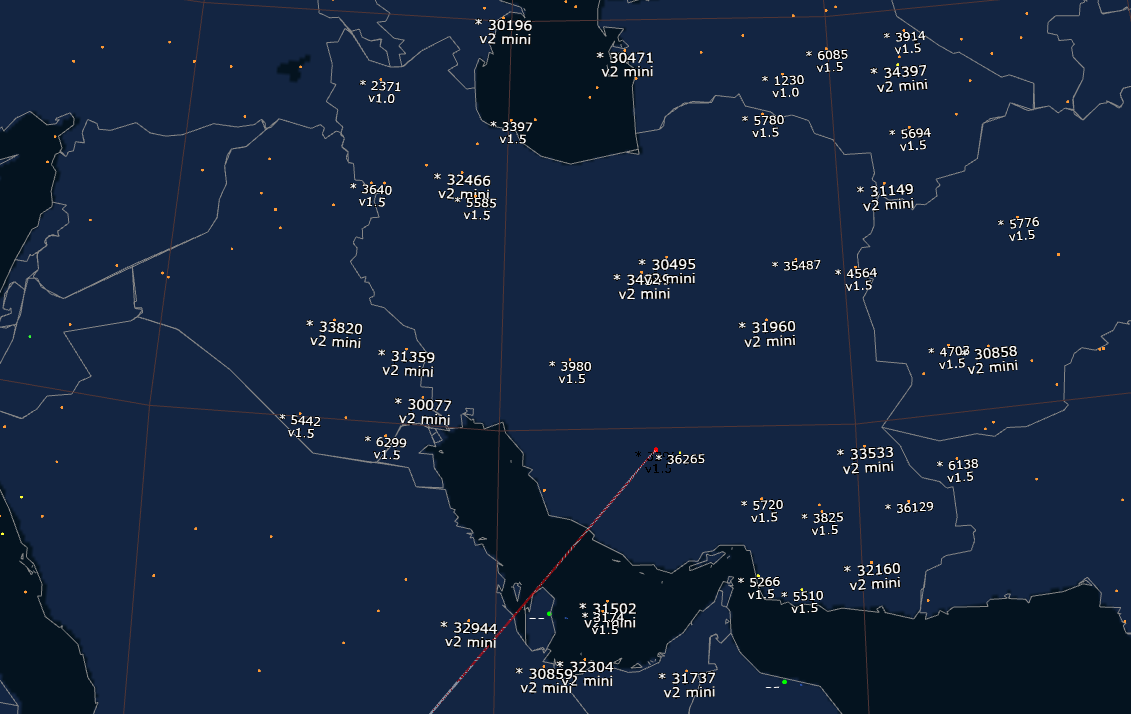
Iran’s own regional interventions, notably in Syria and Iraq, underline what full‑scale civil war entails and Iranians have vivid memories of breakdowns in Iraq and Syria and would prefer not to head in that direction — for the moment. For all its polarisation and sporadic insurgencies in peripheral provinces, Iran’s conflict today looks more like a nationwide intifada than a Syria‑style descent into multi‑sided war. Some more secular Iranians call the Islamic Republic an “occupation”, although this appears to be younger groups and those who despise Shi'ite Islam, and feel the need to resist, similar to the Palestinian "intifada".
The regime’s coercive core
The main brake on outright civil war is the Islamic Republic’s dense coercive architecture. Over four decades, wartime mobilisation and post‑revolutionary consolidation have produced overlapping institutions, the Revolutionary Guard (IRGC), volunteer Basij militia, intelligence agencies and a beefed‑up national police, designed precisely to deter and crush internal revolt. The system has several levers and levels at its disposal, as one London-based analyst said to IntelliNews, “This system was born of revolution, and they haven’t forgotten it; they know how this works.”
After the Green Movement of 2009, the state invested heavily in crowd‑control, surveillance and rapid‑reaction capabilities. The police expanded urban presence, intelligence units embedded in neighbourhoods, and new technologies, from cameras to facial recognition, shipped in by the Chinese. They are not stupid. The IRGC, meanwhile, built provincial garrisons and special headquarters designed for large‑scale internal deployments, adding to the Basij units that have repeatedly opened fire on protesters in recent days. The problem secular protest movements in Iran have had in the past 47 years is that groups like the IRGC are often believers in the Islamic system and would die to keep it in place. Many hundreds of thousands of their predecessors died in the Iran-Iraq War, the US invasion of Iraq, the Syrian civil war, Lebanon and others; they see the defence of the Khamenei-led system as their defining and singular goal.
Civil-military‑relations research suggests that as long as this coercive core remains loyal and relatively united, the threshold to civil war is unlikely to be crossed, even amid widespread protest. The key warning sign would be significant defections or neutrality among security forces, especially if they begin coordinating with Pahlavi, who asked them all to register on his site so he can offer amnesty if he were to win the fight. There is no data currently available on how many have actually crossed that threshold.
Pahlavi’s supporters claim that the secure platform has attracted expressions of interest from disaffected officers, and reports circulate of units refusing orders or failing to report for duty. Independent verification is scarce, not least because internet shutdowns and media controls obscure the view. For now, scattered refusals fall short of the large‑scale, openly declared defections that preceded civil war in places such as Syria, as far as we know from what little information is trickling out.
Precipice, not yet plunge
If Iran is not yet on the verge of civil war, it is arguably on the verge of something else: a protracted confrontation in which neither side can decisively prevail. On one side stands a regime ever more reliant on coercion, digital control and manufactured loyalist rallies to project strength as its revolution era social base narrows and dies off. On the other is a heterogeneous opposition, monarchists, republicans, leftists, islamo-marxists and ethnic activists, that is united in loathing the Islamic Republic but fragmented over what should replace it.
Such stalemates can evolve in several directions. Comparative work on protest campaigns and civil wars notes that resolute, indiscriminate repression can either crush dissent for a time or radicalise it into armed resistance, particularly if external sponsors step in. Conversely, opposition movements that sustain non‑violent discipline, cultivate cross‑class coalitions and peel away elements of the coercive apparatus can trigger negotiated transitions or regime implosion without descending into open war.
Iran’s rulers appear to be betting on the former path: brutal but calibrated repression, combined with economic patronage to key constituencies and a narrative that paints protesters as foreign‑backed “terrorists”. In fact, the Islamic Republic has been openly hacking Pahlavi for years, with many of his private family photos and videos being leaked onto social media to discredit the idea of him as a “King of Kings” but rather a well-to-do man living in his Virginia mansion on the riches of a nation.
Despite these petty moves by the Islamic Republic intelligence, it doesn’t appear to have dented the former royal’s image in the eyes of many inside and outside Iran, who admit that he is probably still the better choice out of the two rival systems known to many of the older generation of Iranians. Pahlavi insists his side are betting on the latter, urging disciplined mass action, strikes and the gradual “disabling” of the regime’s repression machine through quiet defections. Each video message he sends up he ratchets up the pressure on the current system just enough to keep pressure and momentum going, something which has failed in each successive protest movement to date.
For now, civil war remains a more distant scenario rather than a forecast in the next fortnight. Yet the longer a brittle theocracy confronts a mobilised society without credible mechanisms for accommodation, the more plausible that scenario becomes. Iran may not be on the verge of civil war today, but it is edging into a grey zone where miscalculation, split loyalties or foreign adventurism could one day tip unrest into something far worse.
All bets are off.
Unlock premium news, Start your free trial today.


